
OpenAI API in Pakistan: Access, Payment, Latency and Local Options

Written by Muhammad Rizwan
November 5, 2026
10 min Read
Yes, you can use the OpenAI API in Pakistan. Pakistan is on OpenAI's list of supported countries, so developers and companies here can create an account, buy prepaid credits and call OpenAI's models. The harder questions come next: how to pay from a Pakistani card, where your prompts are processed, and how fast responses arrive from servers abroad.
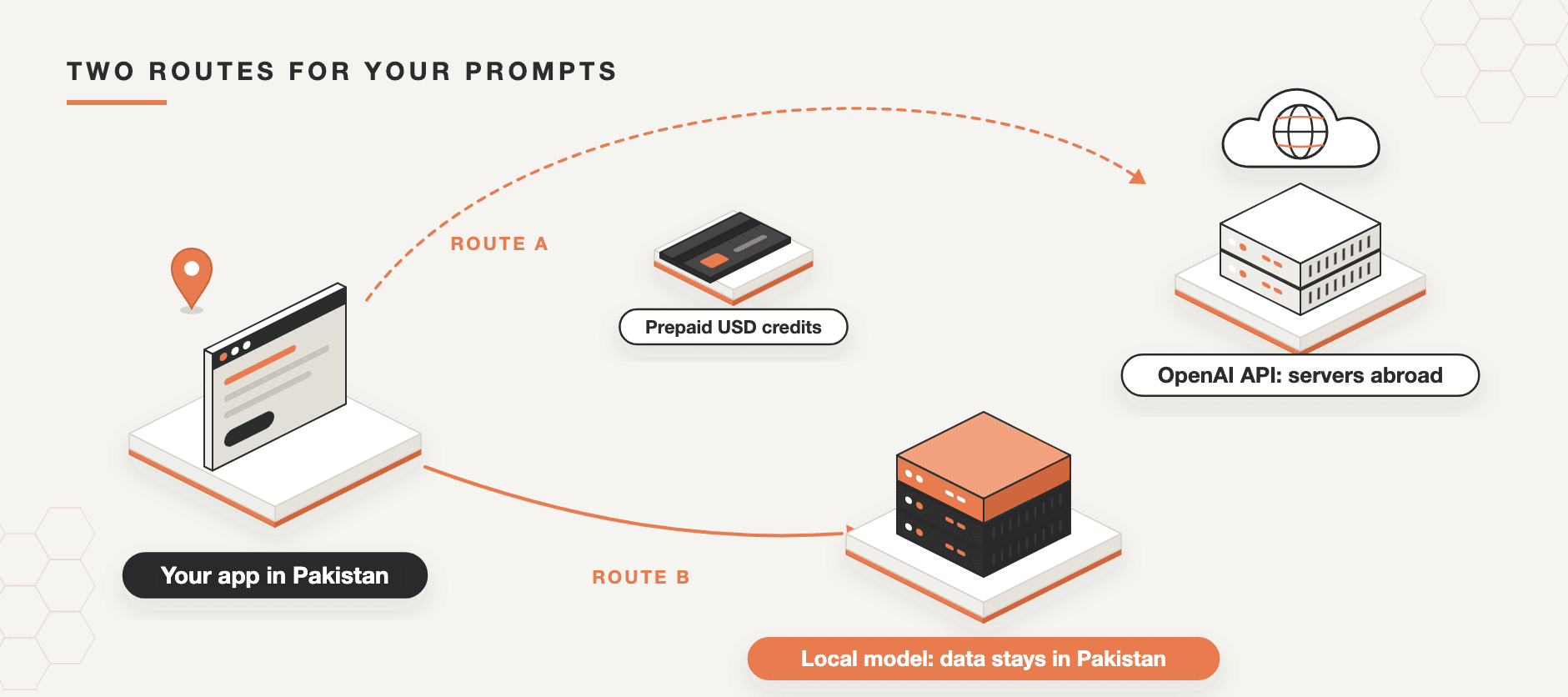
For most prototypes and low-risk apps, the OpenAI API works well from Pakistan. For banks, government bodies and anyone handling customer data, it needs a compliance check first, and a local option is often the better fit: an OpenAI-compatible API running on servers in Pakistan, which is what Stixor AI Hub provides, either in a Pakistani data center or inside your own. Each section below answers one of those questions, with its source.
What is the OpenAI API? The OpenAI API is OpenAI's paid developer service that lets your own software send text, images or audio to OpenAI's models and get answers back. Unlike a ChatGPT subscription, it is billed by usage, measured in tokens (pieces of words), and is meant for building AI into apps, websites and business systems.
Key Takeaways
- Pakistan is a supported country for the OpenAI API; there is no ban on signing up from Pakistan.
- New API accounts pay in advance with prepaid credits, using a card that allows international online payments.
- Set a hard spend limit and keep your API key on your server; a leaked key is the fastest way to lose money.
- OpenAI has no data residency option in Pakistan; the nearest regions it offers are the UAE and India, and only for eligible enterprise customers.
- Banks and government bodies must check the SBP cloud outsourcing framework or the Cloud First Policy before sending customer data abroad.
- Local OpenAI-compatible APIs and private platforms let you keep the same code while keeping data in Pakistan.
Is the OpenAI API Available in Pakistan?
Yes. Pakistan appears on OpenAI's official list of countries and territories where its API is supported.
You can check this yourself on OpenAI's supported countries and territories page. That means a developer in Karachi, Lahore or Islamabad can sign up on the OpenAI platform, create an API key and start building without a VPN or a foreign company.
Two products often get mixed up:
- ChatGPT is the chat app, sold as monthly subscriptions for individuals and teams.
- The OpenAI API is the developer service. You pay per token, and your own app calls the models in the background.
This guide is about the API. If you want AI inside your own software, chatbot, support desk or internal tools, the API (or an API like it) is what you need.
How Do You Get Started With the OpenAI API From Pakistan?
Sign up on the OpenAI platform, add credit, set a spend limit, create a project key, then make your first call.
- Create an account on the OpenAI platform with your work email.
- Add a payment card and buy credit. Your first purchase also moves your organization from the Free tier to the Build tier, which raises your limits.
- Set a hard spend limit. In your organization or project settings, set a monthly spend limit and a spend alert. When the hard limit is reached, requests return an error instead of running up the bill.
- Create a project API key with an expiry date. OpenAI recommends one key per team member, expiry dates and regular rotation (API key safety guide).
- Keep the key on your server. Store it as an environment variable, never in a mobile app, website code or a public code repository, where anyone can copy it and spend your credit.
- Make your first call by following OpenAI's developer quickstart, which covers Python, JavaScript and other languages.
How Do You Pay for the OpenAI API From Pakistan?
New accounts use prepaid credits: you buy credit with a card, and each request draws down that balance.
According to OpenAI's prepaid billing guide, new API accounts use prepaid billing. The details that matter for Pakistani teams:
- Auto-reload is on by default. It buys more credit when your balance drops. Turn it off, or set a monthly reload limit, if you want spending to stop at a fixed amount.
- Credits expire after one year and are generally non-refundable, so buy what you expect to use.
- When credits run out, requests fail. The API returns a billing error (credit_balance_exhausted) until you top up, so production apps need someone watching the balance.
Your limits grow as you buy more credit. OpenAI's rate limits guide sets a monthly usage limit for each usage tier (Free, Build, Launch and Grow), and your organization moves up automatically as its total credit purchases grow. Higher tiers also raise how many requests and tokens you can send per minute, so a new account can hit limits early.
Which card works? According to OpenAI's card decline guide, you need a standard debit or credit card issued by a bank in a supported country; prepaid cards cannot buy API credits. The card must also be enabled for international online payments, which many Pakistani banks switch off by default. OpenAI usually does not receive the reason for a decline, so if a payment fails, call your bank first, complete any OTP or 3D Secure prompt, and turn off your VPN while paying.
Tax and exchange rates. Card payments to companies abroad also attract advance tax under section 236Y of Pakistan's Income Tax Ordinance, which was introduced in 2018 (ProPakistani). The rate has been changed by several Finance Acts since, so check FBR's current withholding tax card before you budget. Add your bank's exchange rate and card fees, and the real rupee cost of your credit is higher than a simple conversion suggests. If dollar billing is the blocker, a local OpenAI-compatible API priced in rupees, like one running on Stixor AI Hub, removes the foreign card and the exchange-rate swing.
For companies, the practical answer is a corporate card with international payments enabled, held by one owner, with auto-reload capped and invoices downloaded each month for finance.
Where Does Your Data Go When You Use the OpenAI API?
Your prompts leave Pakistan: OpenAI has no data residency region here, and its nearest regions are the UAE and India.
OpenAI offers data residency in Europe, the UK, the US, Canada, Japan, South Korea, Singapore, India, Australia and the UAE. For the API, it is available to enterprise customers approved for advanced data controls, who create a project in their chosen region. A standard account set up from Pakistan does not get this.
OpenAI also states two things about data use:
- Training: OpenAI says it does not train its models on API data by default, unless a customer opts in.
- Retention: OpenAI keeps API abuse-monitoring logs, which can include prompts and responses, for up to 30 days by default. Zero data retention is available only to approved customers (OpenAI API docs).
What this means in Pakistan depends on who you are:
- Startups and app builders with no sensitive data can usually go ahead, with a privacy notice that says data is processed abroad.
- Banks, microfinance banks and payment firms must treat it as cloud outsourcing under the State Bank of Pakistan's Framework on Outsourcing to Cloud Service Providers. Agree with compliance how the workload is classed before any customer data goes through.
- Government bodies follow the Pakistan Cloud First Policy. The Ministry of IT's accreditation criteria for cloud providers require processing inside Pakistan for all data except data classed as open or public.
For the wider picture, see Sovereign AI in Pakistan.
How Fast Is the OpenAI API From Pakistan?
Each request travels to OpenAI's servers abroad and back, so there is a network delay on top of the model's own processing time.
For a chatbot or writing tool, this delay is rarely a problem, especially if you stream responses so words appear as they are generated. It matters more for:
- Voice assistants and call-center bots, where a pause of even a second feels slow.
- Agents and workflows that call the model many times in a row, so small delays add up.
- High-volume back-office jobs, where rate limits and retries can slow a batch.
Do not rely on anyone's published speed figures, including ours. Measure time to first token (how long before the first word arrives) and total response time from your own servers in Pakistan, at your real prompt sizes, over a few days.
Can You Use OpenAI Models Through Microsoft Azure Instead?
Yes. Microsoft offers OpenAI models through Azure, which adds Azure billing and more control over where requests are processed.
Microsoft lists UAE North among the regions where its Foundry AI platform is available, but which models are offered varies by region. The deployment type you pick decides where your prompts are processed. Microsoft's deployment types guide says "global" deployments may process data in any Azure region, data zone deployments stay within a Microsoft-defined zone (the US or EU), and stored data stays in your chosen Azure geography.
So Azure can bring processing closer to Pakistan, but it still runs outside the country. It suits companies that already have an Azure agreement and want OpenAI models under it.
What Are the Local Alternatives to the OpenAI API?
You can keep your OpenAI-style code and run open-weight models inside Pakistan, through a local API or a private platform in your own data center.
Stixor AI Hub provides exactly this: open-weight models (published models such as Qwen, DeepSeek or Mistral) running on servers in Pakistan behind one OpenAI-compatible API, so your existing OpenAI code and SDKs keep working and prompts stay in the country. Usage is metered per token, and because billing runs on the platform, token prices can be set in rupees. Other Pakistani providers offer similar APIs. Larger organizations can go a step further and run a private platform on their own servers or private cloud, so prompts never leave their environment. For which models you can run locally, see Access AI Models in Pakistan with Data Sovereignty. If you plan to run models on your own hardware, our GPU as a Service guide explains whether to rent or buy GPUs.
| Option | Where prompts are processed | How you pay | Best for |
|---|---|---|---|
| OpenAI API | Abroad, in OpenAI's regions | Prepaid US-dollar credits by card | Prototypes, apps with no sensitive data, the newest OpenAI models |
| OpenAI models on Azure | Abroad, in the Azure region or zone you choose | Your Azure subscription | Companies already on Azure that want more control over processing location |
| Local OpenAI-compatible API | Inside Pakistan, for its local models | Varies; some providers bill in rupees | Teams that need local processing without buying hardware |
| Private platform | Your own data center or private cloud | Your own infrastructure, with usage charged back per team | Banks, telcos, government and other regulated organizations |
The trade-off is model choice. OpenAI's main models are only available from OpenAI and its cloud partners, so a local option means switching to open-weight models (OpenAI's own open-weight gpt-oss models are one choice that can run locally). For many business tasks, such as summarizing, drafting, search and classification, open models are good enough. Test them on your own prompts, including Urdu and Roman Urdu, before you decide.
How Do You Move an App From the OpenAI API to a Local Option?
If the new API is OpenAI-compatible, you change the web address, the API key and the model name, then test before you switch traffic.
Most apps talk to OpenAI through its official software libraries. Those libraries let you point to a different base web address, so an OpenAI-compatible provider can take the same requests. A safe move looks like this:
- List what your app uses: chat, embeddings, function calling (tools), JSON output, images or audio. Check each one is supported by the new API.
- Build a test set: 50 to 100 real prompts in English, Urdu and Roman Urdu, with the answers you expect.
- Run both side by side: send the same prompts to OpenAI and the local model and compare quality, speed and cost.
- Split traffic by sensitivity: route customer and regulated data to the local model, and keep OpenAI for low-risk work if it scores better there.
- Watch it for two weeks: track errors, response time and spend before moving everything.
Step 4 is where many teams land: not "OpenAI or local", but both, with clear rules about which data goes where. That needs one place to manage keys, budgets and routing for every model.
Which Option Should You Choose?
Choose by the sensitivity of your data first, then by model quality and cost.
- Solo developers and early startups: use the OpenAI API directly. Set a hard spend limit, start with a smaller model and keep customer data out of prompts where you can.
- Growing companies with customer data: add a local OpenAI-compatible option for sensitive workloads, and keep OpenAI for the rest.
- Companies already on Azure: consider OpenAI models through Azure for billing and processing-location control.
- Banks, telcos and government bodies: start from a private platform inside your own environment, and allow outside APIs only for workloads your compliance team approves.
How Stixor Helps
Stixor AI Hub gives Pakistani teams an OpenAI-compatible API for open-weight models running in Pakistan, with per-token pricing that can be set in rupees and prompts that stay in the country.
Through Stixor AI Hub, Stixor provides the local API this guide describes: open-weight models, including models that handle Urdu, running on servers in Pakistan behind one OpenAI-compatible API. You keep your existing OpenAI code and SDKs and change only the web address, key and model name, and your prompts are processed in Pakistan. Usage is metered per token for each key, priced in rupees if you choose, and billed through prepaid credits or on-demand. Each team gets its own keys, model access, request and token limits, and a budget that blocks requests once it is reached, so a runaway script cannot drain your credit.
For organizations whose data must stay inside their own walls, the same platform runs on your own servers or private cloud and can also route approved work to outside providers like OpenAI, so every model sits behind one API. A tamper-evident audit log records sign-ins, changes and model calls. The platform runs on-premise, in a private cloud or fully offline (air-gapped), and supports nine accelerator families, including NVIDIA, AMD and Huawei Ascend, in mixed fleets. To see how it fits together, read How Stixor AI Hub Works.
The hosted API suits developers and companies that want to move off foreign APIs quickly; the private platform suits banks, telcos and government bodies. If you are a single developer with no customer data, the OpenAI API on its own is probably enough.
Related reading: AI Inference in Pakistan, What Is Model as a Service?
The Bottom Line
The OpenAI API is open to Pakistani developers, and for many projects it is the quickest way to start. The decision that matters is which data you send to it. Sort your workloads by sensitivity, keep regulated data local, and use one OpenAI-compatible layer so you can change providers without rewriting your app. Talk to our team about moving your app to Stixor AI Hub's OpenAI-compatible API in Pakistan.

Keep OpenAI, Add a Local Option
Move your OpenAI code to Stixor AI Hub: an OpenAI-compatible API for open-weight models in Pakistan, priced per token in rupees, with team budgets and limits.
Frequently Asked Questions
FAQs
Not for real projects. OpenAI's rate limits guide lists a Free tier for users in eligible countries, but with low limits. Any free credits on an account are used first. For anything beyond testing, buy prepaid credits, which also moves you to the Build tier with higher limits.
Often yes, if it is a standard debit or credit card and your bank has enabled it for international online payments. Prepaid cards are not accepted for API credits. Ask your bank to enable international payments, pay without a VPN, and budget for exchange rates, card fees and advance tax on foreign card payments.
A 429 error means a limit was hit. It can be a rate limit (too many requests or tokens per minute), a hard spend limit you set, or your tier's monthly usage limit. Check the error message, slow down and retry, or raise your limit by buying more credit to move up a tier.
OpenAI says it does not train its models on API data by default unless you opt in. It does keep abuse-monitoring logs, which can include prompts and responses, for up to 30 days by default. Zero data retention is available only to customers OpenAI approves.
Only after a compliance review. Sending customer data to an external AI API is cloud outsourcing under the State Bank of Pakistan's framework, and OpenAI has no data residency region in Pakistan. A common approach is to keep customer data on local or private models and limit outside APIs to approved, low-risk tasks.
Yes. Stixor AI Hub provides an OpenAI-compatible API for open-weight models running in Pakistan, metered per token with prices that can be set in rupees, so prompts stay in the country. Other Pakistani providers offer similar APIs. Larger organizations can also run Stixor AI Hub inside their own data center so prompts never leave their environment.


Discuss Your Enterprise Use Case
From small to large scale enterprises, we deliver next-gen AI, data engineering, and actionable insights.


