
Access Leading AI Models in Pakistan with Sovereignty and Control

Written by Muhammad Rizwan
October 7, 2026
4 min Read
Every API call to a foreign AI provider sends your data outside Pakistan. For enterprises handling financial records, government data, patient information, or defence intelligence, that is not a compromise worth making.
Sovereign AI access means running models on domestic hardware, governed by controls you set, metered by systems you own, and deployed inside your own infrastructure. Stixor AI Hub makes this possible today across nine accelerator families including NVIDIA and Huawei Ascend.
This guide covers which models are available for sovereign deployment in Pakistan, how access governance works at the enterprise level, and what the technical architecture looks like when every token stays inside your jurisdiction.
What Does Sovereign AI Access Mean?
Sovereign AI access is the practice of running artificial intelligence models on compute infrastructure located within a country's borders, with full operational control over data residency, access governance, and billing retained by the organization deploying it.
In practical terms, this means three things. The hardware running inference sits inside Pakistan. Your prompts, context documents, and generated outputs never cross an international border. And you control who can access which models, how much they can spend, and where every token of usage is recorded.
This differs from calling a managed API hosted in a foreign region, where the provider's terms govern your data. It also differs from using a public cloud instance outside Pakistan, where the cloud vendor's jurisdiction applies regardless of which account you signed up with.
According to a July 2026 report by the Associated Press of Pakistan, the National Telecommunication Corporation has signed a three year contract with Data Vault Pakistan to deliver sovereign GPUaaS and MaaS for the federal government, establishing NTC as Pakistan's premier platform for sovereign AI services. The NASTP sovereign GPU supercluster commissioned in September 2026 deploys 1,024 AI accelerators for Pakistani enterprises and research institutions. The infrastructure layer is real and growing.
What has been missing is the platform layer that turns raw compute into a governed, multi tenant, billable AI service. That is what Stixor AI Hub provides.
Why Foreign AI APIs Are a Problem for Pakistani Enterprises
Foreign AI APIs send your data abroad, bill you in dollars, and leave you dependent on another company's decisions. For organisations handling financial, government, health or customer data, those three issues can rule a foreign API out entirely.
Your data leaves the country
Every prompt carries context: a customer record, a contract, a patient note. When the model sits outside Pakistan, that data travels to another country and falls under the provider's terms, not yours. For fintechs, EMIs and digital banks, the SBP's cloud localisation mandate requires core workloads to be hosted domestically by Q4 2026.
Your bill is in dollars
Foreign AI services charge in US dollars. Any fall in the rupee raises your AI bill even if usage stays flat. For a team running millions of tokens a day, that makes AI costs hard to budget.
Your access depends on someone else
A foreign provider sets the prices, decides when to retire a model, and controls which countries can use it. If any of those change, your applications change with them.
Which AI Models Can You Run Inside Pakistan?
The open source model ecosystem in 2026 has reached a point where locally hosted models match or closely approach proprietary API quality for the majority of enterprise use cases.
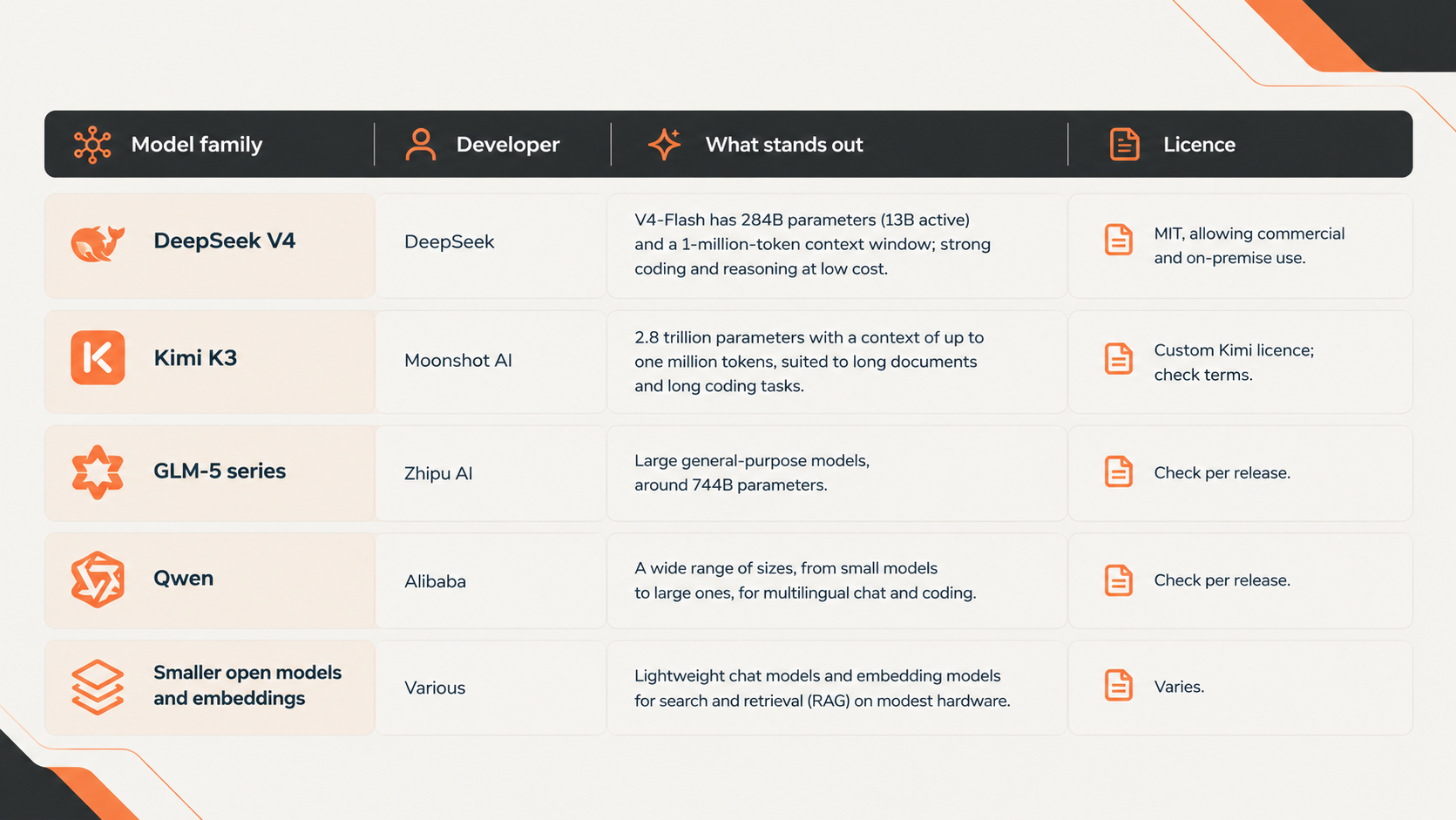
DeepSeek V4 and V4 Flash
Dense and mixture of experts architectures for general purpose chat, reasoning, and code generation. V4 Flash is optimized for high throughput inference where cost per token matters more than maximum capability. Strong performance on code generation benchmarks and multi step reasoning tasks.
Qwen3 Family
Alibaba's latest generation with context windows up to 262,144 tokens. The 27B dense variant runs on a single Huawei Ascend 910B NPU with 64GB memory. Larger variants distribute across multiple accelerators through Stixor AI Hub's automatic tensor parallel scheduling. Particularly strong on multilingual tasks spanning Urdu, English, Arabic, and Chinese, all relevant to Pakistan's trade and communication patterns.
GLM-5 Series
Z.ai's general purpose model with strong multilingual and instruction following performance. Suitable for enterprise applications that need consistent quality across multiple languages and task types.
Kimi K3
Moonshot AI's 2.8 trillion parameter mixture of experts model with over one million token context window. The highest capability model currently available for local deployment. Justified for complex reasoning, full document analysis, contract review, and tasks where the entire document needs to sit inside the context window.
Mistral, Gemma, Phi, and Embedding Models
Mistral for European language work and efficient inference. Gemma for lightweight deployment on resource constrained hardware. Phi for edge and mobile adjacent use cases. BGE and similar models for embedding generation, semantic search, and retrieval augmented generation pipelines.
Stixor AI Hub serves all of these from one model catalogue behind one OpenAI compatible API. Adding new models to the catalogue requires no change to application code. Your developers call the same endpoint regardless of which model they are using or which accelerator is running underneath.
Choosing a model
Bigger is not always better. A trillion-parameter model needs a large accelerator cluster, while a smaller model can answer routine questions on a fraction of the hardware. Most organisations run a mix: a large model for hard reasoning, a fast one for everyday tasks, and an embedding model for search.
Two checks matter before production. Read each model's licence, since some are custom. And test models on your own tasks, especially in Urdu or Arabic, rather than relying on published benchmarks.
How Stixor AI Hub Delivers Sovereign AI Access
Stixor AI Hub is a sovereign AI infrastructure platform that deploys inside your data centre, private cloud, or air gapped environment. It provides three products under one control plane: MaaS (Model as a Service) for governed model access, GPUaaS (GPU as a Service) for compute provisioning, and PaaS (Platform as a Service) for fine tuning and model building.
One API for Every Model
A single OpenAI and Anthropic compatible endpoint serves every model in the catalogue. Applications already built against the OpenAI format migrate with a URL change, not a code rewrite. The same endpoint serves open source models running on your own hardware and external provider pass through, governed identically.
Integrates out of the box with LangChain, n8n, Dify, RAGFlow, Claude Code, and OpenWebUI.
Multi Tenant Governance
Every department, application, or customer becomes a tenant with its own API keys, rate limits (requests per minute and tokens per minute), model entitlements, and budget. RBAC with full resource isolation. SSO through OIDC, SAML, and AD/LDAP. IP allowlisting restricts API access to trusted networks.
Tenants self serve key generation and usage views. Administrators control the model catalogue, tenant entitlements, and hard caps from a central console.
Hard Budget Caps Enforced Before the Call
This is the capability most AI platforms do not have. Two tiers of budget control, both enforced synchronously at the API before the request reaches the model.
The team sets its own budget cap and gets warnings as it approaches the limit. The administrator sets a hard cap the team cannot override. If a tenant hits the hard cap, the request returns a 402 and no tokens are generated. No cost is incurred. No overspend to reconcile after the invoice.
Per key token quotas add a third enforcement layer. A single runaway integration cannot burn through the entire team's budget because the key itself has its own limit.
Nine Accelerator Families, No Lock In
Stixor AI Hub runs on NVIDIA GPUs, AMD GPUs, Huawei Ascend NPUs, T-head PPUs, Hygon DCUs, MetaX, Moore Threads, Cambricon, and Iluvatar accelerators. Mixed fleets from different vendors work in the same deployment. The accelerator is a job attribute, not a platform choice.
This matters in Pakistan where NVIDIA supply faces import constraints and Huawei Ascend availability is increasing. Any sovereign AI platform that only supports one accelerator vendor creates the same dependency problem sovereign deployment was supposed to solve.
Sovereign Deployment Options
On premise inside your own data centre. Private cloud on your own tenancy. Air gapped with zero external dependencies, no outbound connections, no telemetry, no license server. Hybrid mixing on premise for sensitive workloads with cloud for elastic capacity.
Your data stays on your hardware at every layer. Prompts, model weights, generated outputs, usage logs, and billing records all live inside your environment.
How Fine Tuning Works on Sovereign Infrastructure
General purpose models give general purpose answers. They do not know your products, your policies, your medical terminology, or your operational procedures. Fine tuning adapts a base model to your proprietary data so it produces answers accurate in your specific domain.
Stixor AI Hub PaaS provides the full workflow without leaving the platform or sending your training data outside your infrastructure.
Hosted Jupyter notebooks with direct accelerator access. Training jobs with bring your own container flexibility. Curated fine tune recipes for LoRA (low rank adaptation, parameter efficient, runs on a fraction of one accelerator), QLoRA (quantized LoRA, even less memory), and full fine tuning where model size and compute allow. No code tuning through a web interface for teams without ML engineering capacity.
Every trained model version registers in the model registry with training configuration, evaluation metrics, and data provenance. Deploy any registered model to the inference API with one click. It appears in the catalogue immediately, governed and metered like every other model.
The model your data science team fine tunes on Tuesday serves production traffic on Wednesday. No deployment scripts. No platform team handoff. No waiting. And because the entire workflow runs inside your sovereign infrastructure, your training data never leaves your environment.
How Metering and Billing Work
Every API call is recorded with tokens in, tokens out, latency, model identifier, key identifier, tenant identifier, and computed cost. Usage aggregates in real time.
Token metering covers inference. Accelerator second metering covers GPU and NPU compute for training, fine tuning, and notebook sessions. Both feed into the same billing system.
Prepaid credits and on demand billing with clear switchover rules. Per tenant usage records export as invoiceable line items for internal chargeback or external customer billing.
For data centre operators selling AI as a service, this is the billing layer that turns raw accelerator racks into a product. Customers sign up as tenants, generate keys, call models, spin up GPU instances, and get billed automatically.
Where Do the Models Run?
Sovereign model access runs on hardware you control or trust, inside Pakistan: your own data centre, a private cloud, or a domestic AI data centre. The choice depends on how sensitive your data is and how much hardware you want to own.
Deployment options
On premise. The platform runs on your own servers. Common for banks, government bodies and defence work, where data cannot touch outside infrastructure.
Private cloud. The platform runs in your own cloud environment, under your control.
Air gapped. For the most sensitive work, Stixor AI Hub runs with zero external dependencies and no outbound connections.
A domestic AI data centre. Organisations that do not want to own hardware can use capacity in Pakistan's AI facilities, such as Sky47's Karakoram-01 in Islamabad, where Stixor AI Hub runs on Huawei Ascend.
Which hardware runs the models
Pakistan's AI facilities use both NVIDIA GPUs and Huawei Ascend NPUs, so a platform should not force one choice. Stixor AI Hub supports nine accelerator families: NVIDIA, AMD, Huawei Ascend, T-head, Hygon, MetaX, Moore Threads, Cambricon and Iluvatar. Different vendors can run in the same deployment. The scheduler pools servers into one cluster, splits accelerators into fractions for smaller models, and fills idle time with lower-priority work, so applications never need to know which chip answered them.
Who Should Use Stixor AI Hub for Sovereign AI Access
Enterprises with Data Residency Requirements
Banking, government, defence, healthcare, and any organization where data cannot leave Pakistan's borders. Stixor AI Hub deploys inside your perimeter and keeps everything there.
Organizations Running Multiple AI Teams
One team calling one model does not need a governance platform. Twenty teams calling different models with different budgets need tenant isolation, hard caps, and per key attribution. The breakpoint where Stixor AI Hub pays for itself is typically five to ten teams or applications sharing AI infrastructure.
Data Centre Operators and Telcos
If you own or are deploying GPU or NPU hardware, Stixor AI Hub turns that hardware into a sellable AI cloud. Model catalogue, API, tenants, billing, fine tuning, and admin console without spending a year building the platform.
High Token Volume Organizations
At low volumes, per token pricing through a managed gateway is cost efficient. At high volumes, tens of millions of tokens per day, self hosting on local compute with Stixor AI Hub governance becomes significantly cheaper per token despite the infrastructure cost
How to Get Started
Start by finding out where your AI traffic goes today, then move the sensitive workloads first. Five steps cover most organisations.
- Map current AI use. List every application and team calling an AI model, which provider it uses, and what data goes into the prompts.
- Sort workloads by sensitivity. Anything touching customer, financial, health or government data should move to domestic models first.
- Shortlist models and test them on your own tasks. Compare two or three open models on real examples, including Urdu or Arabic where relevant.
- Choose where they run. Your own servers, a private cloud, or a domestic AI data centre, depending on data sensitivity and budget.
- Set up governance before rollout. Create tenants, assign models, set rate limits and budgets, then point applications at the new API.
If you want help with any step, Stixor's AI & ML Solutions and Data Governance Compliance teams work on exactly this.
The Bottom Line
Leading AI models no longer require a foreign API. Open-weight models like DeepSeek, Qwen, GLM and Kimi can run inside Pakistan today. The work that remains is giving every team governed access to them: one API, clear limits, budgets that stop overspend, and a record of every request.
Eighteen months ago, sovereign AI access in Pakistan was a policy aspiration. Today the hardware is deployed at NTC, NASTP, Sky47, and Telenor facilities. Open source models match proprietary API quality for most enterprise tasks. The platform layer to govern, meter, and bill it all exists in Stixor AI Hub.
One API. Every model. Every team governed. Every token metered. Every bill controlled before it happens. Deployed on your infrastructure, inside Pakistan, on your terms.
The question is not whether sovereign AI access is possible. It is. The question is how fast your organization starts building on it

Run leading AI models inside Pakistan, under your control.
Stixor AI Hub gives your teams one governed API for DeepSeek, Qwen, GLM, and Kimi on sovereign infrastructure, with hard budget caps and full data residency.
Frequently Asked Questions
FAQs
Sovereign AI access is the practice of running AI models on compute infrastructure within a country's borders, with the deploying organization retaining full control over data residency, access governance, model selection, and billing. No data leaves the country. No dependency on a foreign provider's infrastructure or terms of service.
DeepSeek V4, Qwen3, GLM-5, Kimi K3, Mistral, Gemma, Phi, and a growing catalogue of open source models can run on local infrastructure in Pakistan through Stixor AI Hub. The platform supports any model that runs on supported accelerator hardware.
Yes. Stixor AI Hub supports nine accelerator families including Huawei Ascend (910B, 910C, 310P), NVIDIA, AMD, T-head, Hygon, MetaX, Moore Threads, Cambricon, and Iluvatar. Mixed fleets from different vendors operate in the same deployment.
Hard budget caps are enforced at the API before the request reaches the model. If a tenant hits its hard cap, the request is rejected. No tokens are generated. No cost is incurred. This is pre call enforcement, not post call reporting. Per key token quotas add an additional layer of protection.
Yes. Stixor AI Hub PaaS provides LoRA, QLoRA, full fine tuning, and no code tuning on sovereign infrastructure. Training data never leaves your environment. Trained models deploy to the inference API with one click.
A standard deployment on existing Kubernetes infrastructure takes two to four weeks from kickoff to first metered API call. Larger deployments with multiple clusters and custom integrations run four to eight weeks.
No. Stixor AI Hub is a commercial platform built and owned by Stixor Technologies. It is sold to enterprises and data centre operators as a sovereign AI infrastructure product.


Discuss Your Enterprise Use Case
From small to large scale enterprises, we deliver next-gen AI, data engineering, and actionable insights.


