
Building Scalable MLOps Pipelines for Enterprise Success
At Stixor Technologies, we help businesses design and implement end-to-end MLOps pipelines that ensure AI and ML models are deployed efficiently, monitored continuously, and scaled securely. From CI/CD automation and performance tracking to enterprise-level optimization, our solutions are built to maximize model reliability and impact.


What Enterprise MLOps Services Include?
MLOps is the engineering discipline that automates the deployment, monitoring, and lifecycle management of machine learning models in production. Enterprise MLOps implementation covers the pipelines, platforms, and processes that turn one off models into a governed engineering practice. Stixor delivers the full chain, from CI/CD for ML and experiment tracking through model registries, feature stores, serving infrastructure, drift detection, automated retraining, and the governance regulated environments demand.
Why Choose Stixor MLOps Team
We design robust MLOps pipelines combining CI/CD automation, monitoring, and scalable infrastructure to ensure reliable model deployment, faster iteration cycles, reduced operational risk, and enterprise-grade performance across production environments.
WHY US
Built for Day Two
MLOps only works when the model, the platform, and the operating practice get designed together. We know where programs fail and engineer around those failure points from day one.
Platform, Not Just Tools
MLOps is not installing MLflow and declaring victory. It is designing how experiments flow into versioned models, deployments get monitored against business metrics, and everything gets governed. Architecture first, tools second.
Your Team Runs It After
We do not build platforms that need our engineers to operate. Every implementation ships with documentation, hands on training, and runbooks so your team deploys, retrains, and investigates drift without calling us back.
Audit Ready Governance
Regulated industries need to prove which data trained a model, which version is live, who approved it, and how it has performed. We implement lineage, approval workflows, bias testing, and audit logs that answer what compliance officers actually ask.
CAPABILITIES
MLOps Implementation Capabilities
Capabilities cover the full lifecycle from experiment tracking through serving, monitoring, and governance. Each one can be engaged on its own or combined into a complete enterprise platform.
CI/CD Pipelines for Machine Learning
CI/CD for ML is the automated pipeline that trains, validates, and deploys models with the same rigor software engineering applies to code. The artifact is a trained model with data dependencies, performance thresholds, and validation gates, not just code.
- Automated training triggered by data changes, schedule, or drift alerts
- Validation gates with accuracy, fairness, and latency checks before promotion
- Staged deployment with canary releases and automated rollback
Experiment Tracking and Model Registry
Experiment tracking logs every training run's parameters, metrics, and artifacts so it can be reproduced. A model registry is the versioned catalog that stages, approves, and governs models from development through retirement. We implement both on MLflow, Weights & Biases, or Neptune.
- Experiment tracking with parameters, metrics, code versions, and data snapshots
- Model registry with versioning, staging, and approval workflows
- Reproducibility infrastructure so any past experiment can be exactly recreated
Feature Store Implementation
A feature store is a centralized system that computes features once and serves them consistently to training and inference, eliminating the training serving skew that silently degrades accuracy in production. We implement Feast, Tecton, or Hopsworks based on scale.
- Offline feature computation for training with batch pipelines
- Online feature serving for real time inference with low latency
- Feature versioning and lineage tracking
Model Serving and Inference Infrastructure
Model serving is the infrastructure that delivers predictions to applications, whether through real time APIs, batch pipelines, or streaming inference. We deploy the pattern that fits your inference profile, with autoscaling, load balancing, and traffic routing.
- Real time inference APIs with autoscaling and latency monitoring
- Batch prediction pipelines for scheduled forecasting and scoring
- Streaming inference on Kafka, Flink, or Spark Streaming
Model Monitoring, Drift Detection, and Retraining
Model monitoring tracks performance in production against statistical metrics and business KPIs. Drift detection identifies when incoming data or model behavior diverges from training. Automated retraining triggers on drift or schedule, retrains on fresh data, and promotes only if the new version outperforms the current one.
- Data and concept drift detection using Evidently AI, Arize, or Prometheus
- Business metric correlation tracking model outputs against real KPIs
- Trigger based retraining with champion challenger validation
ML Governance and Compliance
ML governance is the layer that answers which data trained a model, who approved deployment, how it has performed, and whether it treats different populations fairly. We implement lineage tracking, approval workflows, bias testing, and audit logs for regulated environments.
- Lineage across data, features, training parameters, and code versions
- Approval workflows with role based authorization for promotion
- Bias and fairness testing integrated as a CI/CD promotion gate

Discuss Your MLOps Use Case
A first production model or an organization wide ML platform. Either way, we build the pipelines, monitoring, and governance that make machine learning a reliable engineering discipline your business depends on.
What We Actually Deliver
We deliver end-to-end MLOps pipelines covering deployment automation, monitoring, alerts, retraining workflows, and scalable infrastructure that ensures reliable model performance, faster releases, and continuous optimization across enterprise AI systems.
Deliverable
01
Assess and Design
We start with how your team builds and ships ML models today, not a vendor pitch. Interviews with data scientists, ML engineers, and infrastructure teams map the current workflow, identify where models stall, and shape the target architecture.
- ML workflow audit from notebook to production
- Bottleneck and governance gap identification
- Target architecture with tool selection per layer
02
Implement and Integrate
We build the platform across CI/CD, experiment tracking, model registry, feature store, serving, monitoring, and governance. Each component integrates with your existing stack. Your team works alongside ours during the build.
- Pipelines for training, validation, deployment, and rollback
- Tool deployment across MLflow, Kubeflow, Airflow, or Argo
- Integration with existing CI/CD, cloud, and data platforms
03
Deploy and Validate
We deploy your first real models through the pipeline end to end. Not a demo with sample data. Actual production models go through training, validation, staging, rollout, monitoring, and alert configuration.
- First model deployment on production data
- Monitoring and alert validation across drift and performance
- Operational runbooks with troubleshooting per component
04
Operate and Mature
MLOps platforms mature with use. We monitor reliability, optimize utilization, onboard new models and teams, and help your organization turn MLOps into a capability rather than a one time project.
- Pipeline reliability monitoring with incident tracking
- Onboarding new models to extend the platform
- Resource optimization for compute cost and pipeline runtime
INDUSTRIES
MLOps Work Across Industries
Stixor implements MLOps across regulated and high scale industries worldwide. Model volume, latency requirements, and governance obligations shape what the platform looks like.

Oil, Gas & Energy
Delivered AI-powered anomaly detection systems for real-time operational monitoring, reducing equipment failures, optimizing energy output, minimizing false alerts, enhancing predictive maintenance, enabling smarter decisions, improving safety compliance, and generating significant cost savings.

Logistics & Supply Chain
Stixor delivers AI-driven solutions for Logistics and Supply Chain operations, enhancing shipment tracking, optimizing inventory management, and improving delivery efficiency. Our platforms provide real-time visibility, intelligent automation, and operational resilience driving measurable ROI and enabling data-driven logistics decisions.

Mining and Minerals
We deliver AI-driven solutions for mining, boosting extraction efficiency, equipment reliability, and worker safety. Our platforms enable predictive maintenance, real-time monitoring, and environmental compliance, helping mining companies maximize productivity and achieve sustainable operations.
Technology Stack
Tooling gets chosen against your existing engineering stack, team skills, scale, and governance needs, not from a preferred vendor list.
TOOLS USED

Apache Kafka

PyTorch

Lang Chain
Kubernetes

AWS SageMaker

Docker / K8s
CASE STUDIES
MLOps Programs We Have Delivered
How we have helped organizations build the MLOps infrastructure that took models from notebooks to production systems their business depends on.

Centralizing Corporate Intelligence with GenAI
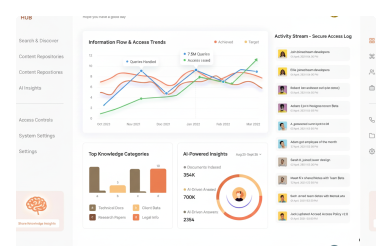
Our AI-powered enterprise knowledge platform enables Mari Energies Limited AI Chatbot, an advanced virtual assistant designed for engineers. Cutting-edge LLM, provides instant, accurate responses to technical queries, enhancing troubleshooting efficiency, reducing downtime, and centralizing technical documents.
Forecasting Water Breakthrough with a Reservoir Intelligence Platform
Our reservoir intelligence platform forecasts when a gas well will start producing water, and how much, years before it happens. Built entirely on data the operator already collects, it combines survival analysis, three-month early warning surveillance, and per-well volume forecasting, validated against Mari Energies own historical breakthrough records

Cutting ATM Cash by 20% with Predictive Analytics
Stixor’s Predictive ATM Cash Optimization Accelerator demonstrates how AI-driven prescriptive analytics can optimize cash liquidity, minimize idle reserves, and ensure uninterrupted ATM availability. By leveraging hierarchical machine learning models, real-time transaction telemetry, and demand-driven replenishment simulations, the platform illustrates potential operational efficiency gains across distributed ATM networks.
Get in Touch with Stixor
Partner with us to understand your business goals and create solutions that drive measurable results. Reach out today and take the first step toward transforming your data into a strategic asset with Stixor.
CONTACT US
What Our Clients Say
TESTIMONIALS
Frequently Asked Questions
FAQs
MLOps is the engineering discipline that automates the deployment, monitoring, and lifecycle management of machine learning models in production. It combines ML engineering, platform engineering, and DevOps practices to turn one off models into a governed, repeatable production system.
DevOps automates the deployment of software code. MLOps automates the deployment of ML models, which adds complexity DevOps was not designed for. In DevOps the artifact is deterministic code. In MLOps the artifact is a trained model whose behavior depends on training data and whose performance degrades as data drifts. MLOps adds data versioning, experiment tracking, feature stores, drift detection, and automated retraining on top of the DevOps foundation.
Yes, but the scope changes. Even a couple of models need experiment tracking, a registry, monitoring, and retraining, or they degrade silently. What small teams do not need is a full feature store, Kubeflow, and a dedicated platform team. We size the footprint to your reality.
Start with your biggest pain point. If experiments cannot be reproduced, start with tracking. If models take weeks to deploy, start with CI/CD. If models degrade silently, start with monitoring. If teams recompute the same features, start with a feature store. Trying to implement everything at once rarely works.
They solve different problems and are often used together. MLflow is the standard for experiment tracking and model registry. Kubeflow is a Kubernetes native platform for orchestrating ML pipelines. Airflow is a general workflow orchestrator. Most enterprise stacks use MLflow for tracking plus Kubeflow or Airflow for orchestration.
Most failures fall into five categories. Data drift shifts the input distribution away from training. Pipeline failures feed stale or wrong data. Training serving skew makes features inconsistent between training and inference. Missing monitoring lets degradation go unnoticed. Manual retraining slows response to problems.
Cost depends on scope, number of models, and organizational maturity. A focused engagement covering CI/CD, model registry, monitoring, and serving for a single team sits at the lower end. Enterprise wide implementations with feature stores, governance, and comprehensive monitoring run considerably higher, delivered in phases.
Yes. Most engagements start with models already deployed but lacking monitoring, versioning, retraining, or governance. We wrap the current deployment in proper MLOps infrastructure without disrupting production. You do not need to rebuild the models to get the benefits.


Discuss Your Enterprise Use Case
From small to large scale enterprises, we deliver next-gen AI, data engineering, and actionable insights.


