
AI Inference in Pakistan: Where to Run It, What It Costs, and How to Choose

Written by Muhammad Rizwan
October 9, 2026
4 min Read
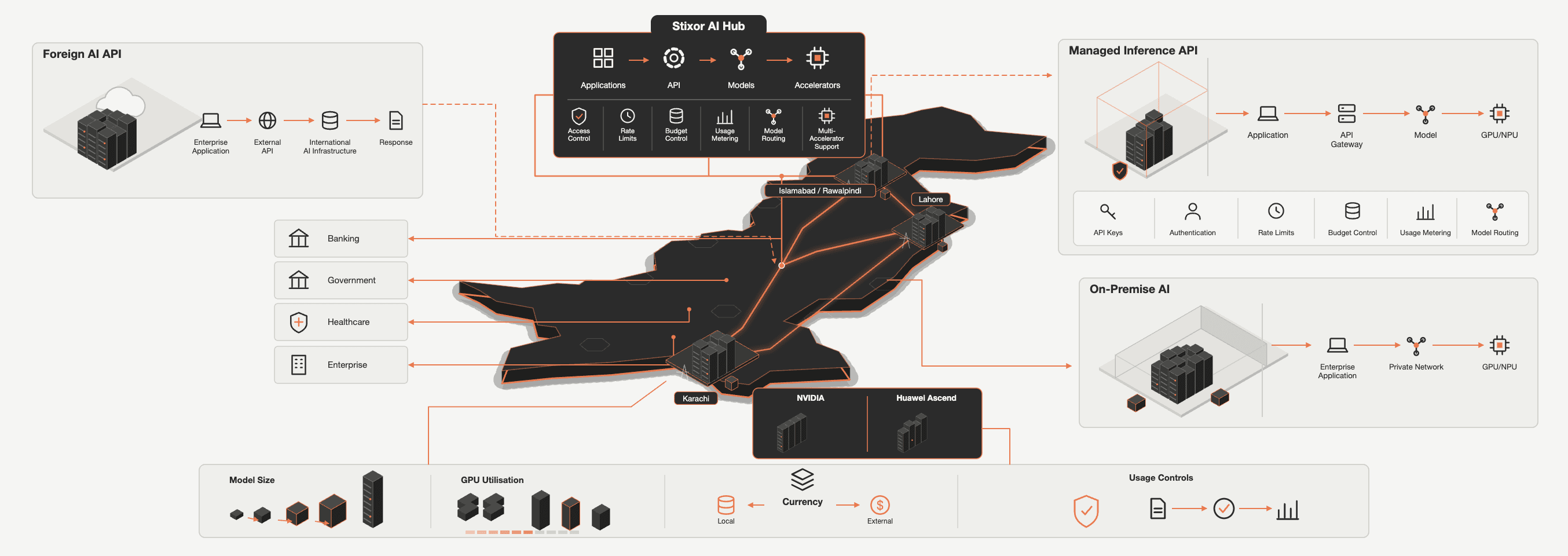
AI inference in Pakistan can now run on local hardware, with prompts and outputs staying in the country. Since late 2025, several onshore facilities have started offering GPU and NPU capacity, and platforms such as Stixor AI Hub turn that capacity into a governed inference API that teams can call, cap and bill in one place.
The harder questions are practical ones. Should you keep calling a foreign API, rent capacity in a Pakistani data centre, or run models on your own servers? What does each option cost, which hardware will you end up on, and which data rules apply to you?
What Is AI Inference?
AI inference is the step where a trained model is put to work on new input, for example answering a customer's question, summarising a contract or scoring a transaction for fraud. IBM defines it as using a trained AI model to make predictions on new data. Training builds the model once. Inference runs every time someone uses it.
That difference shapes the infrastructure. Training a large model takes huge clusters for weeks, and most organisations never do it. Inference happens constantly, in small pieces, and it is where nearly all business use of AI takes place. A chatbot serving 5,000 staff runs inference on every message.
Inference comes in two broad forms. Online inference answers requests as they arrive, which suits chat and live applications. Batch inference processes large volumes together, which IBM notes is a more efficient use of compute and suits overnight document processing or report generation.
For a Pakistani organisation, the question is where those requests are processed: abroad, or here.
Where Can You Run AI Inference in Pakistan?
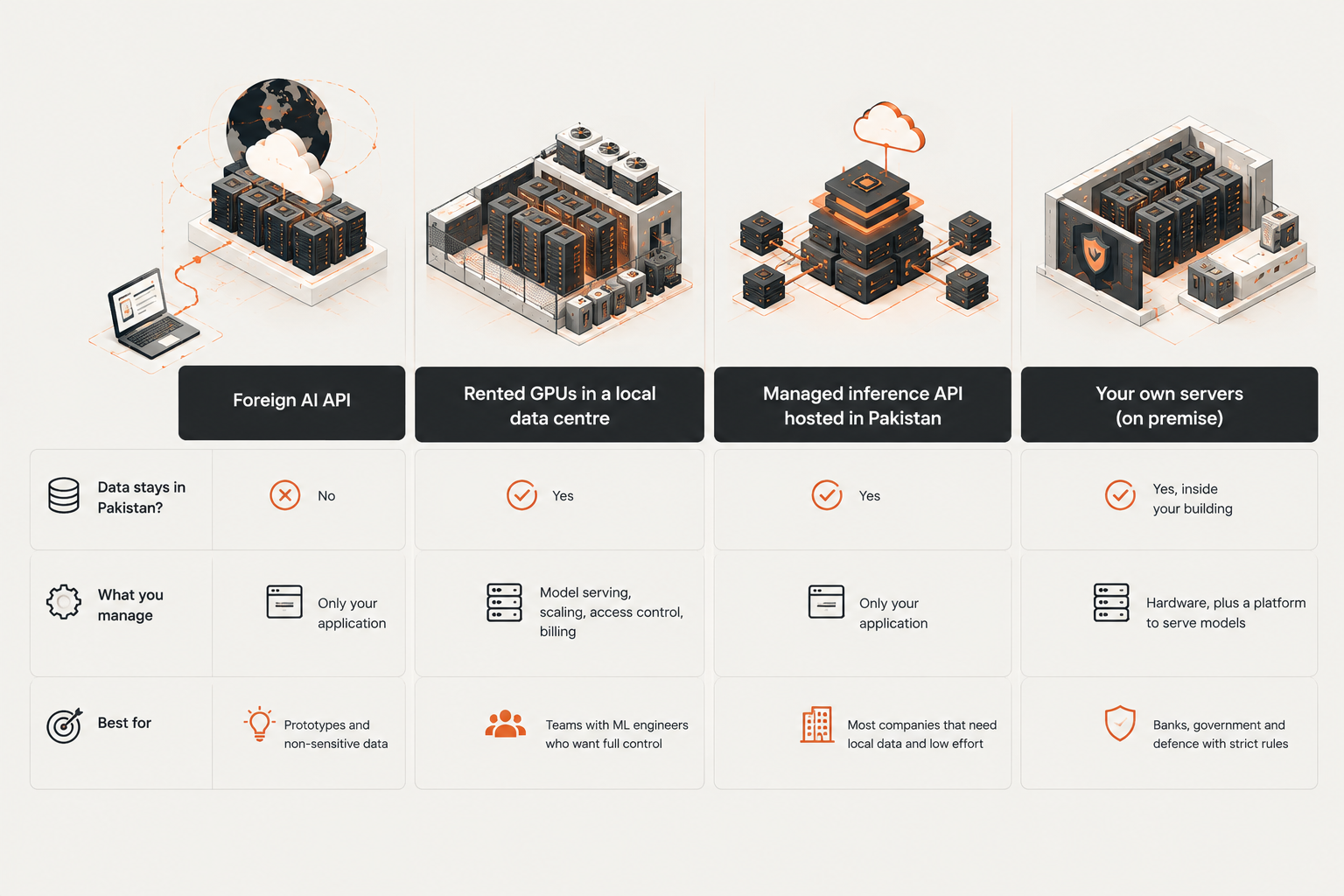
You have four options: call a foreign AI API, rent GPU capacity in a Pakistani data centre, use a managed inference API hosted in Pakistan, or run models on your own servers. The right one depends on how sensitive your data is, how much traffic you expect, and how much infrastructure your team wants to run.
Foreign AI APIs
The quickest start, and often the cheapest per token. DeepSeek, for example, lists V4-Flash at $0.14 per million input tokens and $0.28 per million output tokens on its own API. In exchange, every prompt leaves the country and the bill arrives in dollars. Every request also makes a round trip to a data centre abroad, which adds latency to anything a user is waiting on, such as chat, voice or live fraud checks. And you have little visibility into where your data is processed or stored.
Rented GPUs in a Pakistani data centre
Your data stays local, and you get raw compute to run any open model. But a bare GPU is only half the job. Someone on your team has to load models, keep them running, decide who can call them and track what each team uses.
A managed inference API hosted in Pakistan
The provider runs the models on local hardware and gives you an API, usually compatible with the OpenAI format, billed per token. This gives you local data with almost no infrastructure work. Check whether the provider supports per-team keys, limits and usage reports before you sign.
Your own servers
Maximum control, and sometimes a regulatory requirement. You still need software on top of the hardware to serve models and govern access, which is the role Stixor AI Hub plays in on-premise and air-gapped deployments.
Which Pakistani Facilities Offer AI Compute?
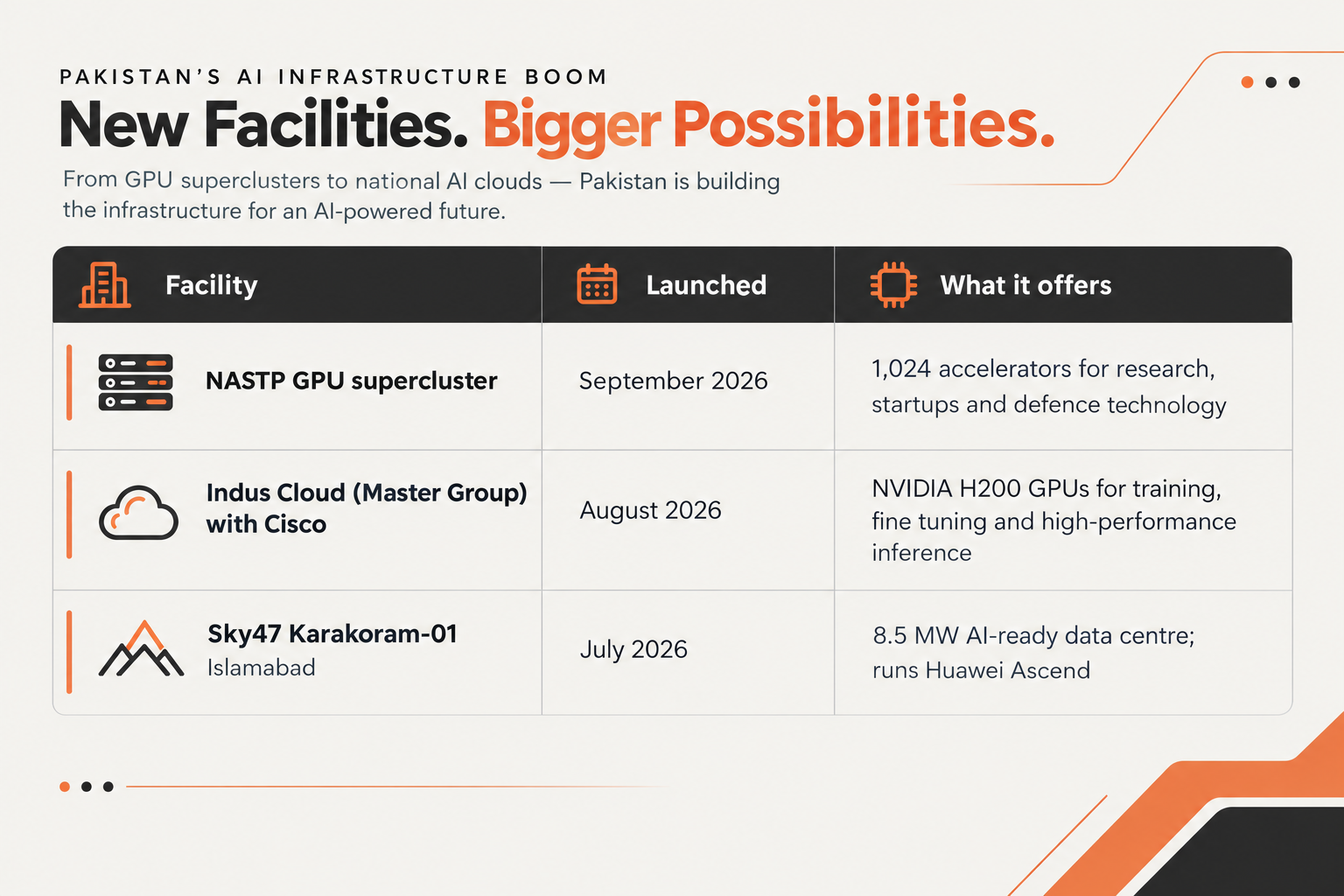
At least four onshore facilities offered AI compute by October 2026, starting with the Telenor and Data Vault AI cloud in November 2025. Most launched within the past year, so check current availability, pricing and access terms directly with each one.
Government workloads have their own track. Data Vault and NTC have signed a contract for sovereign AI services for public-sector users.
Capacity is still modest by global standards. Pakistan had about 23.5 MW of installed data centre IT load in 2025, forecast to reach about 53.3 MW by 2030, so expect to share capacity rather than reserve whole clusters.
What Hardware Runs AI Inference in Pakistan?
AI inference in Pakistan runs on two main accelerator families: NVIDIA GPUs and Huawei Ascend NPUs. Data Vault and Indus Cloud have announced NVIDIA hardware, while Sky47's Karakoram-01 runs Huawei Ascend. Your choice of facility largely decides which one you use.
For most inference work, either can do the job. The differences show up in software. NVIDIA's CUDA ecosystem is the default for most open-source serving tools, while Ascend uses Huawei's CANN stack, so some models need extra work to run well.
Supply matters as well. Relying on a single vendor ties your capacity to that vendor's export rules and delivery times. A serving platform that handles both lets you move workloads if one side becomes scarce. Stixor AI Hub supports nine accelerator families, including NVIDIA, AMD and Huawei Ascend, and can run mixed fleets in one deployment.
How Much Does AI Inference Cost in Pakistan?
There is no single price, because each option charges differently: managed APIs bill per token, rented capacity bills per hour, and your own servers cost money up front. Before comparing providers, estimate your monthly token volume and ask each one for a written quote at that volume.
Four things drive the bill more than anything else.
Model size. Bigger models cost more to run. DeepSeek's own pricing shows the gap: V4-Pro lists output at $0.87 per million tokens, roughly three times V4-Flash. Using a smaller model for routine tasks is often the biggest saving available.
Utilisation. If you pay for capacity by the hour or own it, idle time is wasted money. A June 2026 VentureBeat Research survey found about 83% of enterprises running their own GPUs reported utilisation of 50% or less. Sharing capacity across teams, and splitting accelerators into fractions for small models, raises that figure.
Currency. Dollar-billed services move with the exchange rate. Local billing in rupees removes that risk. See AI Billing in Local Currency.
Uncontrolled usage. A looping script or a leaked API key can burn a month's budget in a day. Budgets that are checked before each request runs stop this; alerts that fire afterwards do not.
Which Data Rules Apply to AI Inference in Pakistan?
If you are a fintech, EMI or digital bank, the SBP's cloud localisation mandate requires core workloads to be hosted in Pakistan by Q4 2026, and that can include AI inference on customer data. Government data has its own residency rules, and a pending data protection bill would widen the requirement to most personal data.
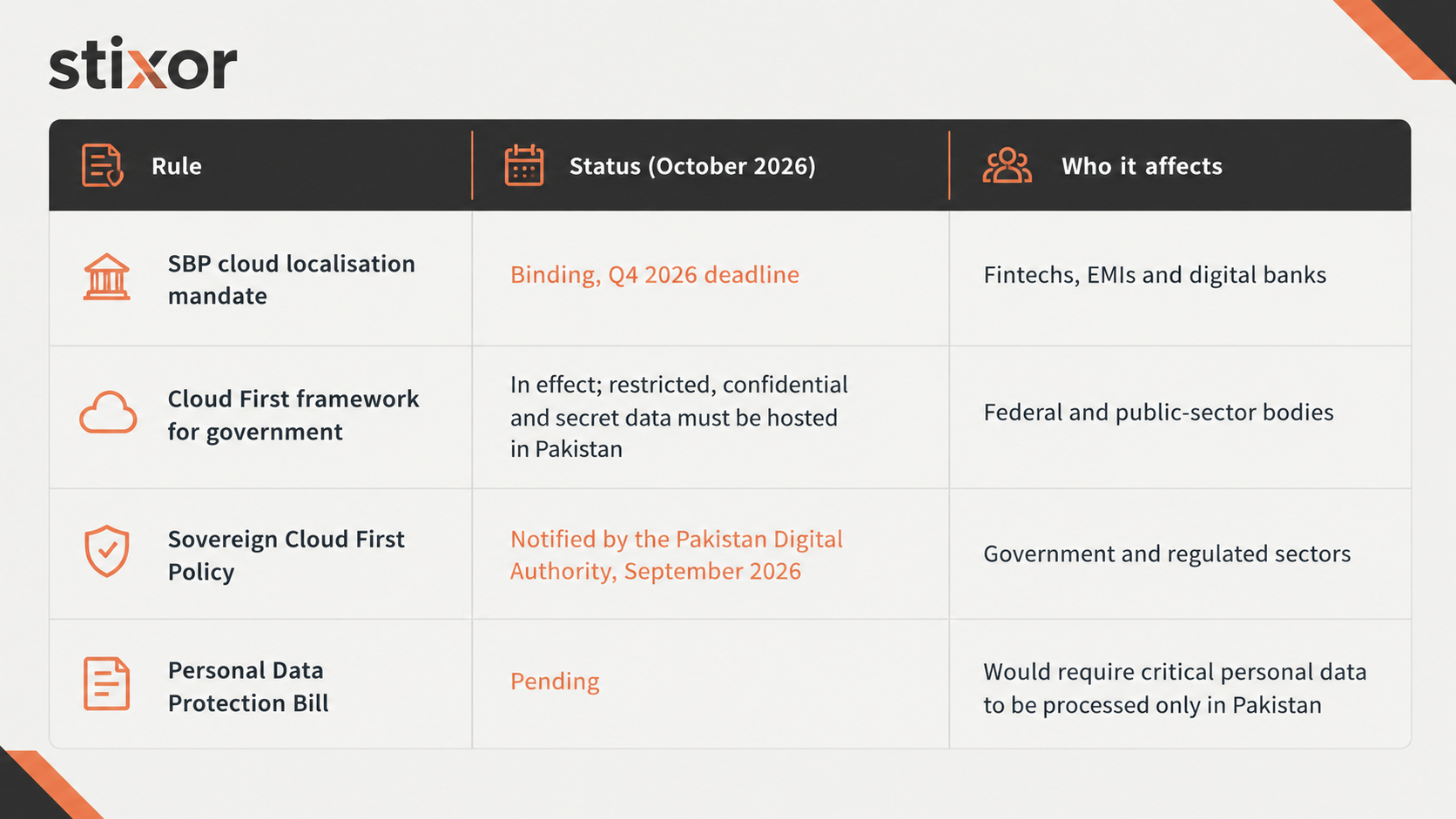
Inference matters here because prompts carry data. A support chatbot sends customer details with every question, and a credit model receives transaction history. If that request goes to a model abroad, the data goes with it.
This is general information, not legal advice. Confirm your exact obligations with your compliance team.
How to Choose an AI Inference Setup in Pakistan
Start with your data, then your volume, then your team. Sensitive data rules out foreign APIs. High, steady volume favours dedicated or owned capacity. A small team favours a managed API over running models yourself.
Work through these questions before you commit:
- What data goes into the prompts? Customer, financial, health or government data should stay in Pakistan. Public or non-sensitive text can go anywhere.
- How many tokens a month do you expect? Low or uneven traffic suits per-token billing. Steady, heavy traffic can justify reserved capacity.
- Which models do you need? Check that the provider can serve them on its hardware, and test them on your own examples, in Urdu where relevant. Our guide to open models you can run in Pakistan lists the current options.
- How will you control access and spending? Look for separate keys per team, rate limits, budgets checked before each call, and usage reports you can bill against.
- Can you move later? An OpenAI-compatible API and support for more than one accelerator family make it easier to change provider or hardware without rewriting applications
Where Stixor AI Hub fits
Stixor AI Hub is the software layer between the hardware and your applications. It puts a catalogue of models behind one OpenAI-compatible API, gives each team or customer its own keys, rate limits and budget, checks budgets before every call, and meters each request for billing. It runs on premise, in a private cloud, fully air gapped, or in a domestic data centre such as Karakoram-01, and it can be used by enterprises governing their own AI use or by data centres selling inference to customers. Our MLOps Implementation Services team helps with rollout.
The Bottom Line
Running AI inference in Pakistan is a real option in 2026, with local GPU and NPU capacity and open models good enough for most business work. The decision now comes down to where your data can go, how much traffic you expect, and how much infrastructure you want to run. Whichever route you pick, put access control and spending limits in place before usage grows.
If you want to see governed, local inference running on your own hardware or in a Pakistani data centre, talk to the Stixor AI Hub team.

Your prompts and logs stay here
Run AI inference in Pakistan, with every request metered and billed locally.
Frequently Asked Questions
FAQs
Yes. Since November 2025, onshore facilities including the Telenor and Data Vault AI cloud, Sky47's Karakoram-01, Indus Cloud and the NASTP supercluster have offered AI compute. You can also run inference on your own servers.


Discuss Your Enterprise Use Case
From small to large scale enterprises, we deliver next-gen AI, data engineering, and actionable insights.


