
What Is Model as a Service (MaaS)? A Complete Guide

Written by Muhammad Rizwan
October 17, 2026
4 min Read
AI use spreads quickly inside an organisation. One team signs up for one model provider, another team for a second, and before long there are dozens of API keys, several vendor bills and no clear view of who is spending what, or which data went where.
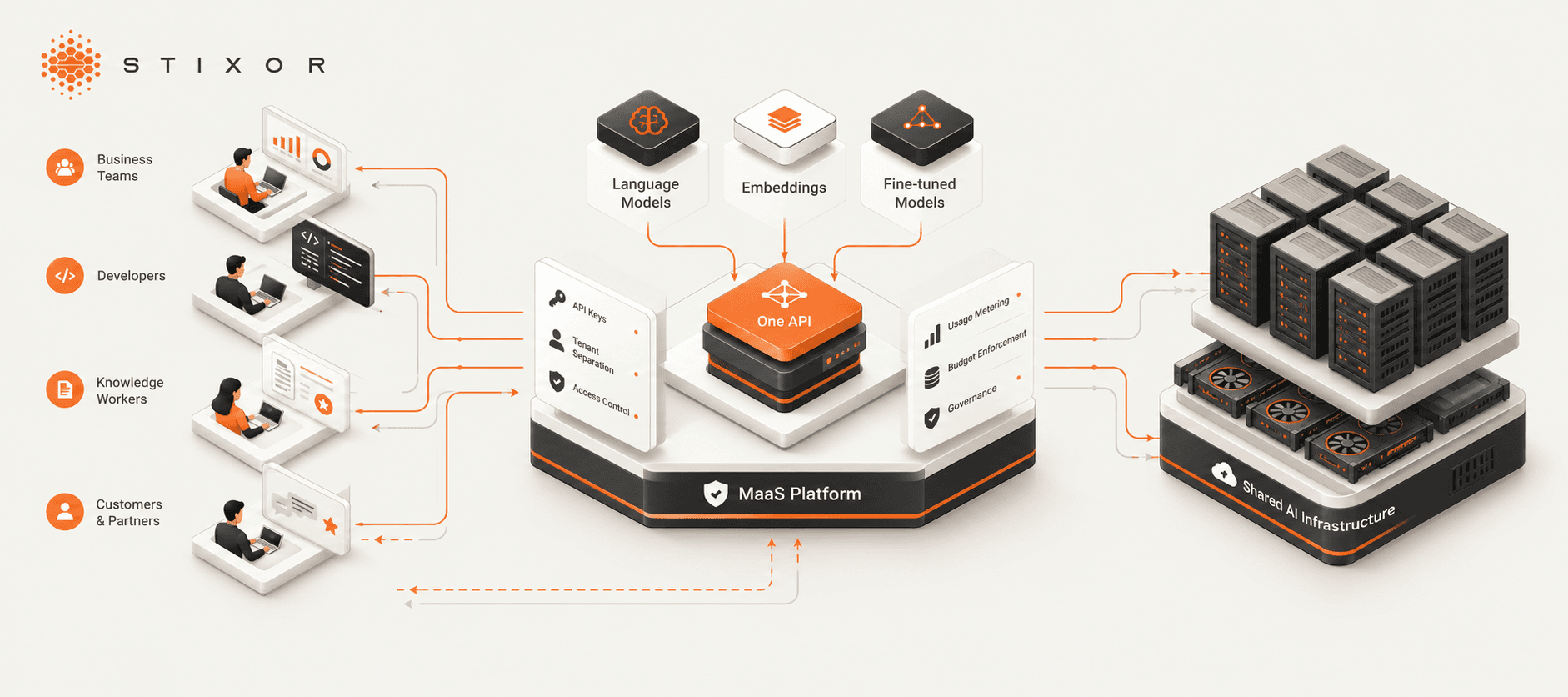
Model as a Service (MaaS) solves that by putting every model behind one managed front door. Your applications call one API, each team gets its own keys and limits, and every request is metered and billed. Stixor AI Hub includes a MaaS of this kind, built to run inside your own data centre or cloud, including in Pakistan.
Key takeaways
- MaaS delivers AI models as a managed service through an API, so teams use models without running the servers behind them.
- A complete MaaS platform adds governance on top of the API: separate keys and limits for each team or customer, budgets, usage metering and billing.
- It sits next to PaaS, where models are trained and fine tuned, and above GPU as a Service, which only rents hardware.
- MaaS can be bought from a public provider or run privately on your own infrastructure, which matters when data has to stay in the country.
What Is Model as a Service (MaaS)?
Model as a Service (MaaS) is a way of delivering AI models as shared, managed services that applications and people access on demand through an API, without deploying or operating the models themselves. The provider, or your own platform team, runs the models; everyone else simply calls them.
The idea grew out of cloud computing's "as a service" models. A widely cited survey describes MaaS as a paradigm that lets developers and users use pre-trained AI models without extensive infrastructure or expertise in model training. Red Hat frames it from the enterprise side: MaaS lets an organisation share access to private models across its teams and applications without giving up control over its data.
In practice, MaaS comes in two forms. Public MaaS is a model provider's API on the internet. Private MaaS runs on infrastructure you control, so you choose the models, set the rules, and keep the data.
How Does Model as a Service Work?
A MaaS platform places a catalogue of models behind a single API, checks every request against the caller's permissions, limits and budget, sends it to the right model, and records what it used. Your developers see one endpoint; the platform handles everything behind it.
What a MaaS platform includes
- A model catalogue: the models your organisation offers, such as open-source language models, embedding models and models you have fine tuned yourself.
- One API for every model: usually in the OpenAI-compatible format, so applications written for it can switch to the platform by changing the base URL.
- Tenants and API keys: each department, application or customer becomes a tenant with its own keys and its own view of usage.
- Rate limits and model access: limits on requests and tokens per minute, and rules for which models each tenant may use.
- Budgets: spending limits per tenant, ideally checked before a request runs, so an overspend is blocked rather than discovered on the invoice.
- Metering and billing: a record of every call, with tokens in and out, cost and time, turned into usage records for internal chargeback or customer invoices.
- Shared model serving: models run on a common pool of accelerators. Popular models stay loaded, less-used models share hardware or load on demand, and many fine-tuned variants can run on one base model.
What happens to a single request
- An application sends a request with its API key, naming the model it wants.
- The platform checks the key: is this tenant allowed to use that model, is it within its rate limits, and does it have budget left?
- If every check passes, the request goes to the model. If not, it is refused with a clear reason, and nothing is spent.
- The model's answer returns to the application, usually as a stream for chat-style use.
- Usage is recorded against the key and tenant: tokens, cost and time.
Where the budget check happens matters. Some tools only report usage after the fact. Checking the budget before the request reaches the model is what turns a spending report into a spending limit.
MaaS vs PaaS, AIaaS, GPU as a Service and AI Gateways
MaaS is where models are used, PaaS is where they are built, AIaaS sells finished AI features, GPU as a Service rents raw hardware, and an AI gateway routes requests to other people's models. The terms overlap, so it helps to compare what each one actually delivers.
MaaS vs PaaS. Platform as a Service for AI (AI PaaS) gives teams notebooks, training jobs, fine tuning and a model registry, so they can create and adapt models. MaaS serves models to applications through an API. They work best together: a model fine tuned in the PaaS is published straight to the MaaS API. Our guide to AI PaaS [internal link: What Is AI PaaS?] covers the build side.
MaaS vs AIaaS. AI as a Service delivers a finished capability, such as transcription, translation or a chatbot. MaaS gives you the models themselves, so you decide how to use them in your own applications and can swap one model for another.
MaaS vs GPU as a Service. GPU as a Service rents accelerators by the hour. You still have to deploy models, build an API, and handle scaling, access and billing yourself. MaaS includes all of that.
MaaS vs an AI gateway. An AI gateway is a proxy that gives one front door to several outside model providers, often with keys and basic limits. A full MaaS platform does that too, but can also serve models on your own hardware, enforce budgets per tenant, and produce invoiceable usage records.
MaaS vs a public model API. A public API from a model provider is a form of MaaS, but you get that provider's models, its regions and its terms. A private MaaS lets you choose open models, run them where your data must stay, and set your own rules for every team.
6 Key Advantages of Model as a Service
MaaS gives your organisation one controlled way to use AI models, so adoption can grow without losing track of cost, access or data.
1. One API instead of many vendor accounts
Developers integrate once, against one API, and can switch models without rewriting their applications. With an OpenAI-compatible API, existing code usually needs only a new base URL.
2. Clear ownership of usage and cost
Every request is tied to a key and a tenant, so you can see exactly which team, application or customer used which model, and what it cost.
3. Spending that stays within budget
Budgets per tenant, checked before each request, stop runaway costs from a looping script or a leaked key before they reach the invoice.
4. Freedom to choose and change models
A catalogue can include open-source models, models you have fine tuned and, where your policy allows, outside providers. Adding a new model does not require any change in the applications that use the API.
5. Better use of hardware
When models are served from a shared accelerator pool, popular models stay loaded, less-used ones share capacity, and many fine-tuned variants can run on one base model. The same hardware serves more teams.
6. Control over where data goes
With a private MaaS, prompts, outputs and usage records stay on infrastructure you control. That is often the deciding factor for banks, government and other regulated organisations.
Types of Model as a Service
MaaS offerings differ mainly in who runs the models and who uses them.
Public MaaS. A model provider hosts its models in its own cloud and sells access by the token. It is quick to start, but you are limited to that provider's models, regions and data terms.
Private enterprise MaaS. An organisation runs its own MaaS platform for internal teams, on its own servers or in a private cloud. Central IT controls which models are available, who can use them and how much they can spend.
Provider MaaS. A data centre or cloud provider runs a MaaS platform on its accelerators and sells model access to its own customers, with self-service sign-up, prepaid credits or pay-as-you-go billing, and usage records for invoicing.
LLM as a Service. A common term for MaaS focused on large language models, used for chat, search, summarisation and agents.
Common Model as a Service Use Cases
Most organisations adopt MaaS to bring order to AI use that has already started, or to turn accelerators into a service others can buy.
- One front door for enterprise AI: every team and application reaches models through one governed API instead of separate vendor accounts.
- Internal chargeback: usage is metered per department, so AI costs can be allocated to the teams that create them.
- Selling AI from a data centre: operators publish a model catalogue and bill customers per token, turning installed GPUs or NPUs into a product.
- Serving fine-tuned models: models adapted to company data or a local language are published to the same API as everything else.
- Regulated workloads: banks, telecoms and government bodies run AI on models hosted where their data is allowed to be processed.
- AI agents and applications: assistants and agents call several models through one API, with limits that stop an agent loop from running up costs.
Challenges of Model as a Service, and How to Handle Them
The main risks of MaaS are data leaving your control, uncontrolled costs, dependence on one provider, and model quality changing over time. Each can be managed with the right platform choices.
Data residency and privacy. Every request sends your prompts and documents to wherever the model runs. With public MaaS, that is the provider's region. If your sector or country restricts where data can be processed, choose a MaaS that runs on your own infrastructure or in a local facility.
Runaway costs. Token-based pricing is easy to start with and easy to lose track of. Budgets per tenant, checked before each request, plus rate limits per key keep spending predictable.
Lock-in. Building on one provider's proprietary API makes switching expensive. An OpenAI-compatible API and a catalogue that includes open models keep your applications portable.
Model quality and change. Models are updated and retired, and a newer version may behave differently. Pin model versions in the catalogue, test new ones before switching, and keep usage records so you can trace what changed.
How to Choose a MaaS Platform: 8 Questions to Ask
Ask these questions before you commit; they separate a simple model API from a platform you can run AI on.
- Where does it run? A provider's cloud only, or also your own data centre or private cloud?
- Which models can it serve? Open-source models, your own fine-tuned models and outside providers, or only one vendor's?
- Is the API OpenAI-compatible? This decides how much code your teams must change.
- How are teams separated? Look for tenants with their own keys, rate limits, model access and usage views.
- When are budgets enforced? Before each request, or only in a report afterwards?
- How detailed is the metering? Tokens in and out, cost and time per key, with usage records ready for chargeback or invoicing.
- How are models served? A shared accelerator pool that can run many fine-tuned variants on one base model uses hardware far more efficiently than one server per model.
- Which hardware does it support? Platforms that run on several accelerator families protect you from shortages and single-vendor pricing.
Model as a Service in Pakistan
In Pakistan, the question is less whether to use MaaS and more where it runs, because every request carries your data to the model.
Local hosting is now possible
Until late 2025, Pakistani companies had to rely on foreign cloud services for advanced AI work. Since then, local AI compute has arrived: the Telenor and Data Vault AI cloud (November 2025), Sky47's Karakoram-01 data centre near Islamabad (July 2026), and Indus Cloud's NVIDIA H200 cluster (August 2026). A private MaaS can now run on hardware inside the country. Our guide to AI inference in Pakistan compares the options.
Which rules apply
For banks, digital banks, EMIs and payment providers, a hosted model service is a cloud outsourcing arrangement under the SBP's Framework on Outsourcing to Cloud Service Providers. For government bodies, restricted, confidential and secret data must be hosted in Pakistan. A MaaS running on local infrastructure keeps prompts, outputs and usage records in the country.
Which models to offer
Open-weight models can run entirely on local hardware, and can be fine tuned for Urdu or industry-specific tasks. Our guide to accessing AI models in Pakistan covers which models are available.
Model as a Service With Stixor AI Hub
Stixor AI Hub provides a full MaaS platform, with one OpenAI-compatible API, tenants, limits, budgets, metering and billing, running inside your own data centre or cloud. It sits between the people who use AI models and the machines that run them, and works with open models on your own servers or with outside providers.
Every team or customer becomes a tenant with its own API keys, which it creates from a web console. Administrators decide which models each tenant may use and set rate limits in requests and tokens per minute. Each tenant can set its own budget, while an administrator sets a hard cap it cannot exceed, and both are checked before a request reaches the model. Every call is metered per key, with tokens in and out, cost and time, and turned into invoiceable usage records on prepaid credits or on-demand billing.
Models are served from one shared accelerator pool, with popular models always on and less-used models loaded on demand, and many fine-tuned variants running on a single base model. The platform supports nine accelerator families, including NVIDIA, AMD and Huawei Ascend, in mixed fleets. Teams that want to train or fine tune their own models use its AI PaaS [internal link: What Is AI PaaS?], and publish the results to the same API. Sky47 uses Stixor AI Hub for its AI cloud at Karakoram-01. For the full architecture, read how Stixor AI Hub works.
The Bottom Line
Model as a Service turns scattered AI use into one governed service: one API, a catalogue of models, and clear rules for who can use what and how much it costs. Public MaaS is the fastest way to start. A private MaaS on your own infrastructure gives you control over models, spending and data, which makes it the natural fit for regulated organisations and data centres in Pakistan.

Give every team AI models through one governed API
Stixor AI Hub gives you a model catalogue, one OpenAI-compatible API, keys, limits, budgets checked before every call, and per-tenant billing, running inside your own data centre or cloud.
Frequently Asked Questions
FAQs
Model as a Service is a way of delivering AI models as managed services that applications and people use through an API, without deploying or running the models themselves. A full MaaS platform also manages access, rate limits, budgets, metering and billing for each team or customer.
MaaS serves ready models to applications through an API. PaaS for AI gives teams notebooks, training and fine tuning to build and adapt models. Platforms that offer both let teams fine tune a model and publish it to the same API.
AIaaS sells finished AI features, such as translation or a chatbot. MaaS gives you the models themselves through an API, so you build your own features and can swap models as better ones appear.
No. GPU as a Service rents accelerators by the hour, and you build everything else. MaaS includes the models, the API, access control, budgets, metering and billing.
Yes. A private MaaS runs on your own servers, in a private cloud or in a local data centre. Stixor AI Hub runs inside your own data centre or cloud, and Sky47 uses it to run its AI cloud in Pakistan.
It depends on where it runs and how it is governed. Look for tenant isolation, per-key access control, usage records for every call, and the option to keep models and data on infrastructure you control.


Discuss Your Enterprise Use Case
From small to large scale enterprises, we deliver next-gen AI, data engineering, and actionable insights.


