
What Is AI PaaS? A Complete Guide to Platform as a Service for AI

Written by Muhammad Rizwan
October 15, 2026
4 min Read
Every organisation wants AI that understands its own data, its own customers and its own language. Achieving this often requires training or fine tuning models on organisation-specific data. Yet, many teams get stuck before they even begin, having to set up accelerators, frameworks, training pipelines and deployment infrastructure before they can focus on building AI solutions.
AI PaaS, or Platform as a Service for AI, removes this complexity by providing data scientists and engineers with a ready-to-use environment to explore data, train and fine tune models, and deploy them to production, while the platform manages the underlying infrastructure. Stixor AI Hub includes an AI PaaS designed to run in any country, within an organisation’s own data centre or cloud, supporting local data localisation requirements and applicable regulatory frameworks, including those specific to Pakistan.
Key takeaways
- AI PaaS provides a managed environment where teams build, train, fine tune and deploy AI models without managing servers, accelerators or tooling.
- It sits between GPU as a Service, which rents raw hardware, and Model as a Service, which delivers finished models through an API.
- The main advantages are faster time to production, better use of expensive accelerators, cost control per team, and the option to keep training data on your own infrastructure.
- For organisations in Pakistan, where the platform runs matters as much as what it does, because fine tuning uses your most sensitive data.
What Is AI PaaS?
AI PaaS (AI platform as a service) is a managed platform for developing AI models, covering everything from data exploration and training to fine tuning, versioning and deployment. You bring your data and your use case; the platform supplies the notebooks, compute, training tools, experiment tracking and deployment path.
The term builds on a long-standing cloud model. NIST defines Platform as a Service as letting users deploy their own applications using the provider's languages, libraries and tools, without managing the underlying servers, networks or storage. AI PaaS applies the same principle to models. Instead of building application code on a managed runtime, your teams build and adapt models on managed accelerators.
How Does AI PaaS Work?
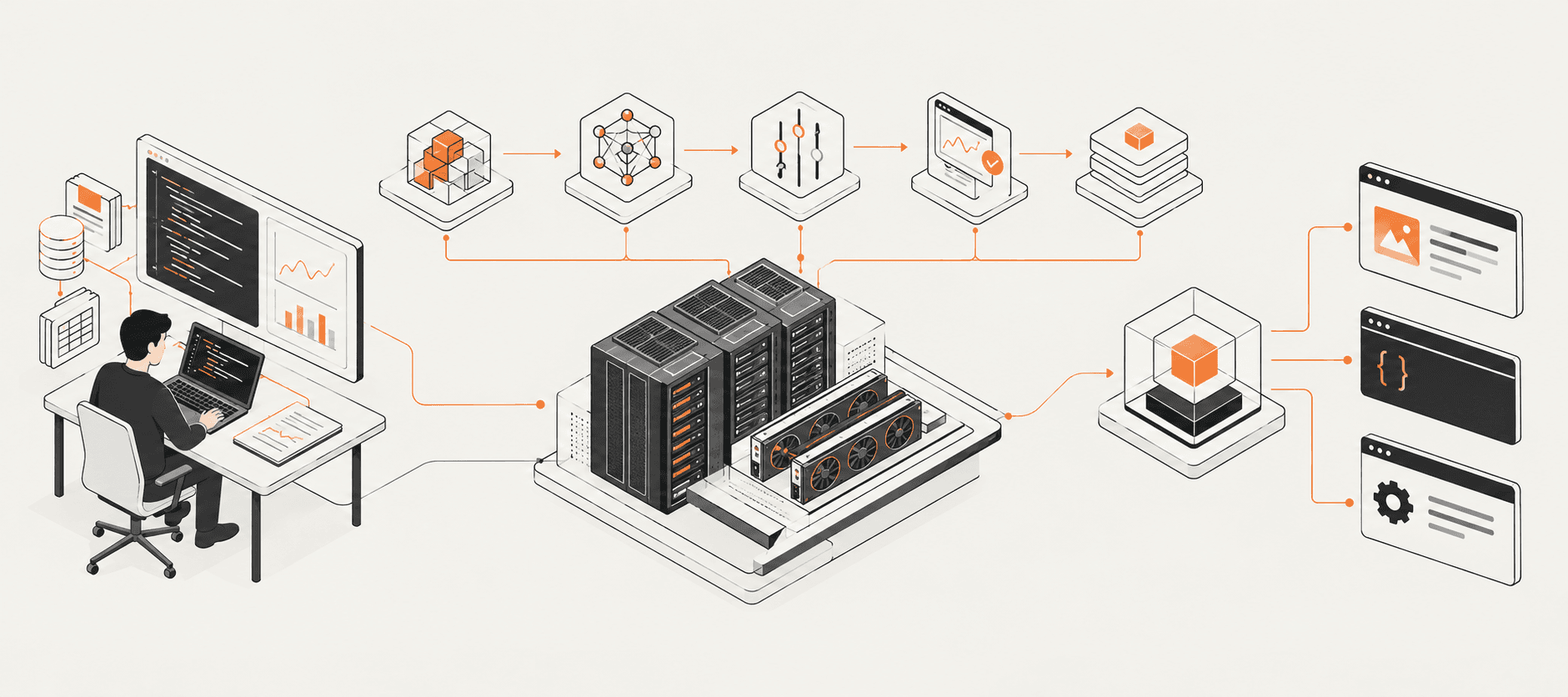
An AI PaaS gives your teams a set of ready tools on shared accelerators, and moves each model through the same path: explore, train, compare, register and deploy. You don't manage servers, drivers or schedulers; you work on the model.
What an AI PaaS includes
Most platforms include six core components:
- Hosted notebooks and compute: managed Jupyter notebooks with GPUs or NPUs attached on demand, plus direct compute access for larger jobs.
- Training jobs with your own containers: package your code and libraries in a container and run it as a job, without being tied to one framework.
- Fine-tuning methods: built-in LoRA, which trains small adapter layers; QLoRA, which does the same on a compressed model to save memory; and full fine tuning, which updates every weight. Our guide to LoRA vs QLoRA vs full fine tuning [internal link: Blog 20] explains when to use each.
- No-code tuning: a guided interface that lets analysts and domain experts adapt a model without writing training code.
- Experiment tracking: a record of every run's settings, data version and results.
- Model registry and deployment: a catalogue of approved model versions that can be published as a service in one step.
From notebook to production in five steps
- Explore. A data scientist opens a notebook, attaches an accelerator and tests ideas on a sample of the data.
- Train or fine tune. The promising approach becomes a training job, and the scheduler runs it on free accelerators.
- Compare. Experiment tracking shows which run performs best.
- Register. The chosen model is saved as an approved version, with a record of how it was produced.
- Deploy. The model is published as a service other teams and applications can call, under the same access controls and usage metering as any other model.
Behind the scenes, a good platform splits accelerators so several small jobs can share one, runs urgent work ahead of background jobs, and fills idle time with lower-priority work, so expensive hardware does not sit unused.
AI PaaS vs AIaaS, IaaS, GPU as a Service and MaaS: What's the Difference?
IaaS and GPU as a Service rent you hardware, AI PaaS gives you the environment to build models on that hardware, Model as a Service gives applications finished models through an API, and SaaS gives users a finished application. Vendors use these terms loosely, so it helps to ask what each one actually delivers.
Traditional PaaS is a managed place to build and run web applications, with runtimes, databases and deployment pipelines. It is designed for application code, not for training models on accelerators.
IaaS and GPU as a Service (GPUaaS) provide servers or accelerators by the hour. You get the hardware, but installing frameworks, scheduling jobs, tracking experiments and building a deployment path are left to you.
GPU PaaS applies platform-as-a-service principles to the GPUs themselves: it pools GPUs across clusters and clouds, splits them into smaller units, isolates tenants, gives teams self-service access and tracks usage for chargeback. Some GPU PaaS products also add preconfigured notebooks and inference pipelines. Its focus is delivering GPU capacity, while an AI PaaS is organised around the model lifecycle, with fine-tuning methods, experiment tracking and a registry that publishes models as an API.
AI PaaS delivers that full workflow: notebooks, training jobs, fine tuning, experiment tracking and a registry that deploys models. It runs on accelerators, but teams never manage them directly. Some products are hosted cloud services that include the compute; others are software installed on an organisation's own servers or a data centre's hardware.
Model as a Service (MaaS) gives applications access to ready models through one API, with keys, rate limits, budgets and billing. PaaS is where models are created and adapted; MaaS is where they are consumed. When a platform offers both, a model fine tuned in the PaaS can be published straight to the MaaS API. Our guide to Model as a Service covers that side.
AI as a Service (AIaaS) and SaaS deliver finished AI capabilities, such as translation, transcription, sentiment analysis or a chatbot, ready to use through an app or API. You don't train or change the model; you use what the provider built. AI PaaS goes deeper: it gives you the tools to train and adapt models on your own data, so you control how the model behaves.
6 Key Advantages of AI PaaS
AI PaaS shortens the path from idea to production model and gives you control over cost, hardware and data. These are the main benefits.
1. Faster time to production
Your teams start on day one with notebooks, fine-tuning methods and deployment already in place. A model that works in an experiment can be published as a service in one step, instead of waiting for another team to rebuild it.
2. Less infrastructure work
The platform handles accelerator scheduling, drivers, frameworks and environments. Data scientists spend their time on data and models, and your platform team maintains one shared system instead of many one-off setups.
3. Better use of expensive accelerators
GPUs and NPUs are costly, and they often sit idle. Slicing accelerators between small jobs, prioritising urgent work and filling idle time with background jobs gets more useful work out of the same hardware.
4. Cost visibility and control per team
Compute is metered per team or project, with budgets and priority tiers. Finance can see who used what, and charge it back, instead of receiving one large bill with no breakdown.
5. Security and data residency
Each team's data, jobs and models are isolated from the others. When the platform runs in your own data centre or a local facility, your training data never has to leave your environment, which matters for regulated sectors and for countries with data residency rules.
6. Freedom of models and hardware
A good AI PaaS works with open models and your own containers, and with more than one accelerator family. That protects you from lock-in to a single model provider or chip vendor.
Types of AI PaaS
AI platforms differ mainly in where they run and how much of the model lifecycle they cover.
Hosted cloud AI PaaS. Run by a cloud provider in its own data centres, with compute included. Quick to start, but your data and models live in the provider's environment and region.
Self-hosted AI PaaS. Software you install on your own servers, in a private cloud, or on a data centre's accelerators. You keep full control of data and hardware. This is the model Stixor AI Hub follows.
GPU PaaS. Pools GPUs across clusters, partitions them into smaller units, isolates tenants and gives teams self-service access with chargeback. Some products add notebooks and inference pipelines, but the focus is on delivering and sharing GPU capacity rather than managing models from fine tuning to deployment.
Low-code or vertical AI platforms. Built for one task, such as building chatbots or document processing, with little need for code. Easy to use, but limited if you need to train or fine tune your own models.
Common AI PaaS Use Cases
Most organisations use an AI PaaS to adapt existing models to their own data, rather than train models from scratch. Typical uses include:
Fine tuning language models on company knowledge, such as policies, contracts or technical manuals, so answers reflect your organisation.
Local-language models, adapting open models to Urdu, Arabic or regional languages.
Banking and fintech: fraud detection and credit risk models trained on your own transaction history.
Energy and manufacturing: predicting equipment failures from sensor data, and checking product quality from camera images.
Telecoms and retail: forecasting demand and churn, and fine tuning support assistants on real customer questions.
Training and fine tuning as a service, where data centres and cloud providers offer notebooks and fine tuning to their own customers, alongside raw compute.
If your teams only call finished models through an API, you may not need an AI PaaS at all; a model API service is enough. Training is still a large share of AI spending: Gartner expects $19 billion of AI-optimised infrastructure spending to go to training in 2026, alongside $23.3 billion for inference.
Challenges of AI PaaS, and How to Handle Them
The common problems with AI PaaS are data privacy, skills, integration and cost, and each one can be managed if you plan for it before choosing a platform.
Data privacy and compliance. Fine tuning uses your most sensitive data, and hosted platforms process it in the provider's environment and region. Check which rules apply to you, such as the SBP's cloud outsourcing framework in Pakistan or the PDPL in Saudi Arabia, and prefer a platform that can run in your own data centre or a local facility.
Skills gaps. A platform removes infrastructure work, but your team still needs to understand data preparation and model evaluation. No-code tuning helps domain experts take part, and training or an experienced implementation partner closes the rest of the gap.
Integration with existing systems. A model only creates value when your applications can use it. Choose a platform that deploys models behind a standard API, such as an OpenAI-compatible API, so existing applications can connect without major rework.
Runaway compute costs. Training jobs can consume expensive accelerators quickly. Look for metering per team, budgets and priority tiers, so costs are visible and capped before they surprise you.
Lock-in. Platforms tied to one cloud, one model provider or one chip vendor are hard to leave. Open models, your own containers and multi-vendor hardware support keep your options open.
How to Choose an AI PaaS: 8 Questions to Ask
Most platforms look similar in a demo; these eight questions reveal the differences that matter once real teams and real data are involved.
- Where does it run? Public cloud only, or also in your own data centre or private cloud? This decides whether sensitive training data can stay where it is.
- Which accelerators does it support? A platform tied to one chip vendor leaves you exposed to shortages and price changes. Look for support for several accelerator families, and for mixed fleets.
- Can teams bring their own containers? Fixed environments are easy to start with but become limiting when teams need specific libraries or frameworks.
- Which fine-tuning methods are built in? At minimum LoRA, QLoRA and full fine tuning, plus a no-code option for non-specialists.
- How does a trained model reach production? Ask whether it deploys from the registry in one step, and whether it then sits under the same access and billing controls as other models.
- How are compute costs controlled? Look for usage metering per team, budgets, priority tiers, and accelerator slicing so small jobs don't occupy a whole card.
- How are teams kept apart? Each team's data, jobs and models should be isolated, with roles and audit records.
- Who owns the models and data? Confirm that you own your fine-tuned models and that your data is never used to train the provider's models.
AI PaaS in Pakistan: What Changes When Data Must Stay Local?
Until late 2025, Pakistani companies had to rely on foreign cloud services for advanced AI work, because local GPU capacity was scarce. That is no longer the only option, and for regulated organisations it is often not the right one.
Local compute is now available
Telenor and Data Vault launched Pakistan's first locally hosted AI cloud in November 2025, offering GPU as a Service inside the country, and Data Vault later announced a partnership with Rafay Systems to add a self-service GPU and Kubernetes platform layer. Indus Cloud launched an NVIDIA H200 cluster in August 2026, and Sky47's Karakoram-01 data centre near Islamabad, which opened in July 2026, runs its AI cloud on Huawei Ascend. Our guide to sovereign AI in Pakistan covers these facilities in detail, and our guide to accessing AI models in Pakistan covers which open models you can run and fine tune locally.
Training data is usually the most sensitive data
Fine tuning means sending real customer records, transactions or internal documents to the platform. For banks, digital banks, EMIs and payment providers, a hosted AI PaaS is a cloud outsourcing arrangement under the SBP's Framework on Outsourcing to Cloud Service Providers. For government bodies, restricted, confidential and secret data must be hosted in Pakistan. A PaaS that runs on local infrastructure, or on your own servers, keeps that data inside the country.
Plan for two hardware families
Pakistan's AI compute now runs on NVIDIA at some facilities and Huawei Ascend at others. A PaaS that supports both lets teams use whichever capacity is available, instead of rewriting their work for one vendor.
Build and Fine Tune Models With Stixor AI Hub
Stixor AI Hub is an AI platform that combines a PaaS for building and fine tuning models with a Model as a Service API for using them, running inside your own data centre or cloud. It sits between your teams and the machines that run your models, and works with open models on your own servers or with outside providers.
Its PaaS gives your technical teams hosted notebooks and compute, training jobs with their own containers, LoRA, QLoRA and full fine tuning, no-code tuning, experiment tracking, and a model registry that deploys to the platform's OpenAI-compatible API in one click. Once published, a fine-tuned model appears in the same catalogue as every other model, with the same keys, rate limits, budgets and usage metering.
Models are served from one shared accelerator pool, and many fine-tuned variants can run on a single base model, so adapting models does not multiply hardware costs. Training compute is metered per accelerator-second for chargeback or customer billing. The platform is built on Kubernetes with accelerator slicing, priority tiers and spot backfill, and supports nine accelerator families, including NVIDIA, AMD and Huawei Ascend, in mixed fleets. Sky47 uses Stixor AI Hub for its AI cloud at Karakoram-01. For the full architecture, read how Stixor AI Hub works.
The Bottom Line
AI PaaS is where models are explored, trained, fine tuned and prepared for production on shared infrastructure. It earns its place when several teams need to adapt models on their own data, especially when that data is sensitive. Before choosing one, check where it runs, which accelerators it supports, how a trained model reaches production, and how compute costs are controlled. For organisations in Pakistan, start with the question of where training data will be processed.

Train and fine tune models on infrastructure you control
Stixor AI Hub gives your teams notebooks, training, fine tuning and one-click deployment to a single API, running inside your own data centre or cloud.
Frequently Asked Questions
FAQs
AI PaaS, or platform as a service for AI, is a managed environment for building, training, fine tuning and deploying AI models. It provides notebooks, compute, training jobs, experiment tracking and a model registry, so teams can work on models without building the infrastructure themselves.
Traditional PaaS manages the runtimes, databases and deployment pipelines for web applications. AI PaaS applies the same idea to models, managing the accelerators, training pipelines, experiment tracking and deployment needed to take a model from experiment to production.
No. GPU as a Service rents accelerators by the hour and leaves the tooling to you. An AI PaaS runs on accelerators too, but adds notebooks, training jobs, fine-tuning methods, experiment tracking and deployment on top.
GPU PaaS applies platform-as-a-service principles to GPUs: it pools them across clusters and clouds, splits them into smaller units, isolates tenants and gives teams self-service access with usage tracking. Some products also include notebooks and inference pipelines. An AI PaaS is centred on the model itself, with fine-tuning methods, experiment tracking and a registry that publishes models as an API.
Model as a Service (MaaS) gives applications access to ready models through an API. PaaS is where models are trained and adapted. Platforms that offer both let teams fine tune a model and publish it to the same API in one step.
Yes. Local facilities now provide AI compute, and a PaaS can run on infrastructure inside Pakistan or on your own servers. Stixor AI Hub, including its PaaS, runs inside the organisation's own data centre or cloud, and Sky47 uses it at Karakoram-01.
It depends on the platform; some support only NVIDIA. Stixor AI Hub supports nine accelerator families, including NVIDIA, AMD and Huawei Ascend, and can run mixed fleets.
No. If your teams only call finished models, a model API service is enough. A PaaS becomes useful when you need to fine tune models on your own data, train custom models, or let several teams build and deploy models on shared infrastructure.
Lock-in happens when your models, data or workflows only work on one provider's platform or one chip vendor's hardware. To avoid it, choose a platform that runs open models and your own containers, supports more than one accelerator family, uses a standard API format such as the OpenAI-compatible API, and lets you keep and export the models you fine tune.
AIaaS (AI as a Service) gives you finished AI capabilities, such as translation or a chatbot, that you use without training anything. AI PaaS gives you the tools to train and fine tune your own models on your own data, so you control how they behave.


Discuss Your Enterprise Use Case
From small to large scale enterprises, we deliver next-gen AI, data engineering, and actionable insights.


