
How to Choose an LLM Provider in Pakistan: 8 Questions to Ask

Written by Muhammad Rizwan
November 5, 2026
5 min Read
To choose an LLM provider in Pakistan, settle three things before you compare models: where your prompts are processed and stored, which rules cover your data, and how well the models handle Urdu and Roman Urdu. Price and model rankings matter, but they rarely decide the shortlist.
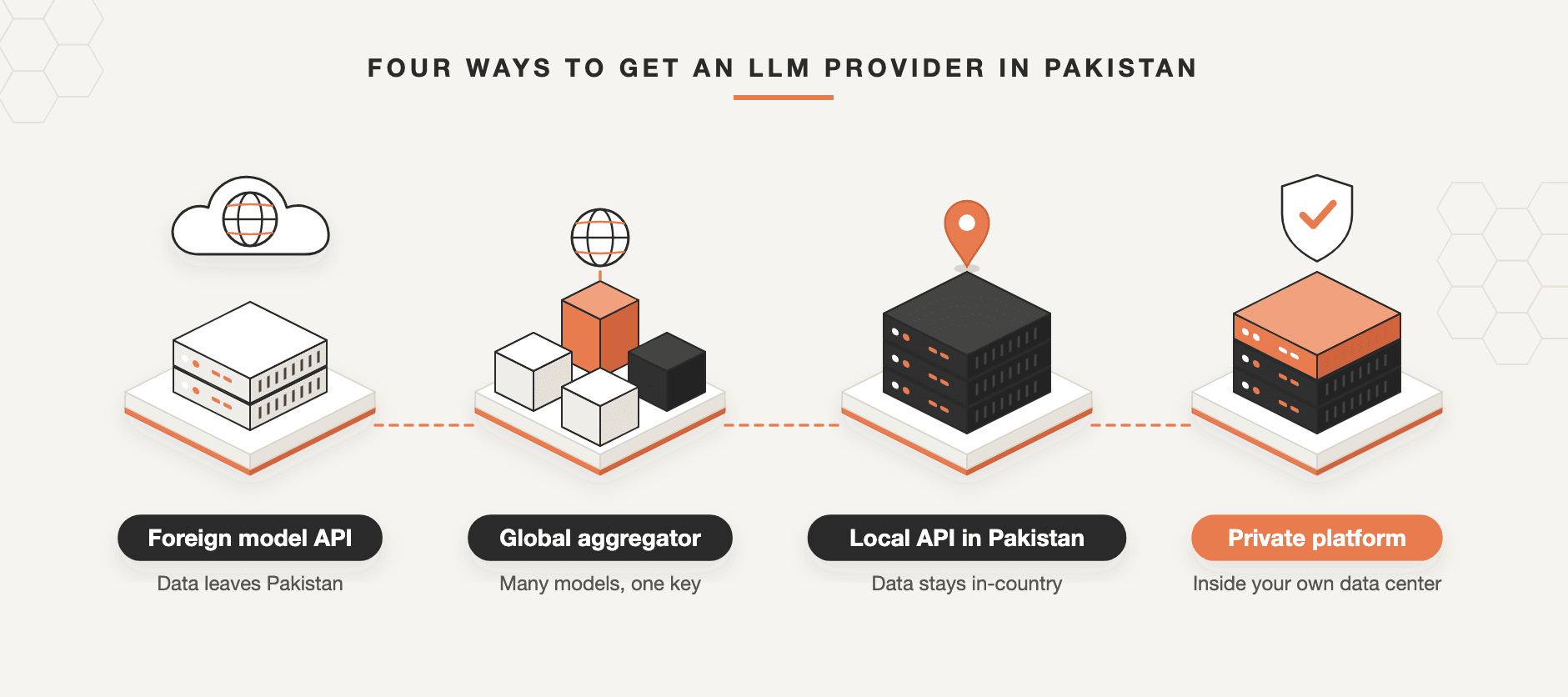
Most Pakistani enterprises end up with one of four setups: a foreign model lab's API, a global aggregator, a local shared API, or a private platform such as Stixor AI Hub inside their own data center or cloud. The eight questions below, in the order they usually remove options, show which one fits.
What is an LLM provider? An LLM provider is the company or platform that runs large language models and lets your applications use them, usually through an API (a web address your software sends prompts to). The provider decides where requests are processed, which models you can call, what is kept, how you are billed and what controls you get.
Key Takeaways
- Ask where each request is processed, per model, not per company.
- Check your regulator first: banks follow the SBP cloud outsourcing framework; government bodies follow the Cloud First Policy.
- Test Urdu and Roman Urdu on your own prompts; English benchmark scores do not carry over.
- An OpenAI-compatible API and open-weight models keep your exit cost low.
- Pick a shared API or a private deployment by how sensitive the data is, not by price alone.
1. Where Is Each Request Processed and Stored?
Ask the provider to name, for every model you will use, the country where prompts are processed and where logs are stored.
A provider can serve some models from Pakistan and pass others to data centers abroad. If its sales team cannot answer this for a specific model, your compliance team will not be able to answer an auditor either. Ask about backups and support access too: data processed in Pakistan can still be copied or viewed abroad.
2. Which Rules Apply to Your Data?
Your regulator decides what is allowed, so check the rule that covers you before you shortlist anyone.
- Banks, MFBs, DFIs, EMIs and payment firms: the State Bank of Pakistan's Framework on Outsourcing to Cloud Service Providers (BPRD Circular No. 01 of 2023) governs all cloud outsourcing, using a risk-based approach. Sending customer data to an external LLM API falls under it.
- Government bodies: under the Pakistan Cloud First Policy, the Ministry of IT and Telecom's accreditation criteria for cloud providers require processing inside Pakistan for all data except data classed as open or public.
- Everyone else: check client contracts, which often limit where customer data may go.
For more detail, see Sovereign AI in Pakistan.
3. How Well Do the Models Handle Urdu and Roman Urdu?
Test models on your own Urdu and Roman Urdu prompts, because English benchmark scores do not predict Urdu quality.
The UrduMMLU benchmark (arXiv preprint) tested 30 models on more than 26,000 questions drawn from native Urdu question banks and public exam papers. Only one model passed 85% accuracy, and many scored 25 to 40 points lower on Urdu humanities than on science subjects. A model that looks strong on maths can still get local history, law or culture wrong.
Roman Urdu (Urdu typed in English letters, as on WhatsApp) has even fewer public tests. If your customers write that way, score every shortlisted model on 50 to 100 of their real messages.
4. Can You Switch Providers Without Rewriting Your App?
Choose an OpenAI-compatible API and open-weight models, so leaving costs a configuration change, not a rebuild.
An OpenAI-compatible API accepts requests in OpenAI's format, which most AI tools already use; open-source serving software such as vLLM offers it too. Switching then means changing a web address and a key. Open-weight models (published models such as Qwen, DeepSeek or Mistral) add a second exit: you can run the same model yourself or elsewhere.
5. Do You Need a Shared API or a Private Deployment?
Use a shared API for low-risk work and a private deployment, inside your own data center or cloud, for regulated or sensitive data.
| Setup | Where requests run | Best for | Watch for |
|---|---|---|---|
| Foreign model lab's API | Abroad | Newest proprietary models; no residency needs | Dollar billing; data leaves Pakistan |
| Global aggregator | Abroad, across many providers | Trying many models with one key | Unclear location per model; dollar billing |
| Local shared API | Partly or fully in Pakistan | Local processing without hardware | Which models are local; retention |
| Private platform | Your own data center or cloud | Banks, telcos, government, sensitive data | Hardware or capacity; setup time |
If you have no residency requirement and dollar cards are not a problem, a foreign API or aggregator is often the simplest choice. Once customer data or a regulator is involved, a local shared API or a private platform is usually the only fit. For renting versus owning the hardware behind a private platform, see our GPU as a Service guide.
6. Can You Control Access and Spend for Each Team?
Look for per-team keys, per-model access, rate limits and budgets that block requests before money is spent, not reports after it.
The costly failure is rarely a bad model. It is a leaked key, a runaway loop or a pilot that quietly becomes a large bill. Ask whether each team can have its own key limited to approved models, and whether every call is recorded in an audit trail.
7. What Does the Provider Keep, and for How Long?
Get the retention period for prompts, responses and logs in writing.
Policies differ even among the biggest providers. OpenAI, for example, keeps API abuse-monitoring logs, which can include prompts and responses, for up to 30 days by default, and zero data retention needs its approval (OpenAI API docs). The answer should match what your privacy notice tells customers.
8. How Do You Pay, and Who Answers When It Breaks?
Confirm the billing currency, the invoice format and who supports you in your time zone.
A dollar invoice brings a foreign card and a budget that moves with the rupee. Ask for prepaid credit or monthly invoices, usage broken down by team, and an on-call contact for production. Local platforms can remove the dollar problem: Stixor AI Hub, for example, lets token prices be set in rupees. For cost planning, see AI Inference in Pakistan.
How Should You Test a Shortlist Before You Sign?
Run a two-week trial with your own prompts, measured from where your users are.
- Collect real prompts: 50 to 100, in English, Urdu and Roman Urdu.
- Score blind: two business users rate answers without knowing which model wrote them.
- Measure speed from Pakistan: time responses from your office or data center.
- Test limits: send a burst of traffic and watch errors and rate limits.
- Check the bill: compare the provider's usage report with your own request count.
How Stixor Helps
Stixor AI Hub gives you both local setups: an OpenAI-compatible API for open-weight models running in Pakistan, and a private platform inside your own data center or cloud, including fully offline (air-gapped) sites.
Through Stixor AI Hub, Stixor provides a local OpenAI-compatible API: open-weight models, including models that handle Urdu, running on servers in Pakistan, so prompts stay in the country. Usage is metered per token, prices can be set in rupees, and billing runs through prepaid credits or on-demand. Organizations that need a private platform can run the same software on their own servers, with approved models, open models or outside providers you choose, behind that one API. Each team gets its own keys, model access, request and token limits, and a budget that blocks requests once reached. A tamper-evident audit log records sign-ins, changes and model calls. It supports nine accelerator families, including NVIDIA, AMD and Huawei Ascend, in mixed fleets. See How Stixor AI Hub Works.
The hosted API suits teams that want local processing without buying hardware; the private platform suits banks, telcos, government bodies and companies with several AI teams.
Related reading: Access AI Models in Pakistan with Data Sovereignty, What Is Model as a Service?
The Bottom Line
Start with question 2: once you know which rules cover your data, half the options usually drop out. Then run a short trial on your own prompts. If your models need to run inside your own environment, talk to our team about Stixor AI Hub.

Run LLMs Your Way in Pakistan
Give every team one API to approved models, with budgets, limits and audit trails, inside your own data center or cloud.
Frequently Asked Questions
FAQs
No single model is best for every Urdu task. In the UrduMMLU benchmark, results varied widely, and most models were much weaker on Urdu humanities than on science. Test shortlisted models on your own Urdu and Roman Urdu prompts before choosing.
Any cloud outsourcing by a bank, including sending customer data to an external API, falls under the State Bank of Pakistan's cloud outsourcing framework. Agree with your compliance team how the workload is classed under the framework before any customer data is used.
Not necessarily. Requests that stay in Pakistan avoid long international network routes, which can help responses start sooner. Overall speed also depends on model size, hardware and load, so measure it from your own location during the trial.


Discuss Your Enterprise Use Case
From small to large scale enterprises, we deliver next-gen AI, data engineering, and actionable insights.


