
What Is an AI Token Factory? How a GPU Cluster Becomes a Managed AI Service

Written by Muhammad Rizwan
October 26, 2026
4 min Read
An AI token factory is an AI infrastructure environment that delivers model inference through an API and measures usage in tokens. Instead of charging customers only for access to hardware by the hour, an operator can sell managed AI inference based on the tokens customers consume.
Building one takes more than fast inference. The operator needs a control layer that identifies each caller, manages model access, enforces usage limits, records token consumption and turns usage data into billable records.
Stixor AI Hub provides an example of this software layer. Its Model as a Service (MaaS) capabilities support API-based model access and token metering, while its Platform as a Service (PaaS) capabilities extend to model development and deployment workflows. The platform sits between computing infrastructure and the applications or customers using it.
This guide explains how an AI token factory works, how it differs from GPU rental, which operational metrics matter, and what businesses should consider before building or buying one.
Key Takeaways
- An AI token factory sells inference usage. Customers access models through an API, and consumption is measured in tokens.
- GPU rental remains a separate offering. Operators can sell dedicated or hourly computing capacity alongside token-metered inference.
- A control layer connects infrastructure to revenue. Model serving, tenant management, access controls, rate limits, budgets and metering make the service manageable.
- Utilization affects profitability. Under usage-based pricing without minimum commitments, the operator generally carries more idle-capacity risk.
- Metering and billing are different processes. Every usage record needs to be reconciled with the applicable pricing and billing rules.
- Data location matters to enterprise buyers. Regulated organizations need to understand where inference runs, how information is handled and which requirements apply to their workloads.
What Is an AI Token Factory?
An AI token factory is an operating model in which AI infrastructure delivers model inference as a managed service and measures consumption in tokens.
A token is a unit of text processed by a language model. Depending on the model and request, usage can include input tokens from prompts and other context, as well as output tokens generated in the response.
The operator manages the infrastructure and model-serving environment behind an API. Customers send requests to that API, and the platform handles access, usage controls, inference and consumption records.
NVIDIA uses the token factory concept when discussing AI data centers that convert available power and computing capacity into inference throughput and revenue. Its discussion emphasizes performance per watt and the economics of producing tokens at scale.
Source: NVIDIA: Scaling Token Factory Revenue and AI Efficiency by Maximizing Performance per Watt.
In this article, AI token factory refers to the operating model for delivering token-metered AI inference through a managed service. It is a descriptive industry term, not a standardized technical architecture or a guarantee of any particular capability
Why Are Operators Building AI Token Factories?
AI inference creates a recurring operational workload. Once a model is deployed, applications may call it continuously to answer questions, summarize documents, extract information, generate content or support business processes.
An operator can expose those models through an API and charge according to consumption. This gives customers a way to access managed inference without independently provisioning and operating the underlying accelerators.
The commercial model also changes the operator's responsibilities. Rather than earning primarily from reserved hardware capacity, the operator needs to manage shared demand, maintain service quality, record usage accurately and control the cost of producing each response.
Gartner's 2026 forecast discusses spending on AI-optimized infrastructure as a service, including the growth of inference-related infrastructure demand. That is relevant market context, but infrastructure spending is not the same measurement as revenue earned by token factories.
Source: Gartner's 2026 AI-optimized infrastructure spending forecast.
How Is an AI Token Factory Different from GPU Rental?
The difference is what the customer buys and who carries the cost of unused capacity.
With GPU rental, a customer pays for access to computing resources, often by the hour or through a reserved-capacity agreement. The customer manages the workloads running on those resources, subject to the service agreement.
With token-metered inference, the operator hosts the model-serving environment and exposes an API. The customer pays according to usage, while the operator manages the infrastructure needed to produce the requested output.
These models can coexist. A provider may rent GPUs to customers who need control over their own software stack while offering managed inference to customers who prefer an API.
When Should You Rent GPU Hours?
GPU rental can make more sense when customers:
- Need dedicated computing resources or control over their software environment.
- Run long training jobs or specialized workloads that do not fit a hosted inference service.
- Need to install custom software, manage their own models or control scheduling decisions.
- Have predictable capacity requirements and prefer reserved or hourly pricing.
When Should You Sell Tokens?
Token-metered inference can make more sense when:
- Many customers need access to a shared set of hosted models.
- Demand varies throughout the day, but workloads can be pooled across tenants.
- Customers prefer an API rather than managing accelerators and model-serving software.
- The operator can manage utilization, inference performance and the cost of serving each request.
Under usage-based pricing without minimum commitments, token sales shift more idle-capacity risk to the operator. Infrastructure costs continue even when demand falls, while revenue depends on the tokens customers consume.
The key question is not simply whether token pricing is better than hourly pricing. It is whether the operator can serve enough demand at an acceptable cost while maintaining the required performance and service quality.
How Does a GPU Cluster Become an AI Token Factory?
A GPU cluster becomes an AI token factory when the infrastructure is connected to a managed model-serving and usage-control layer.
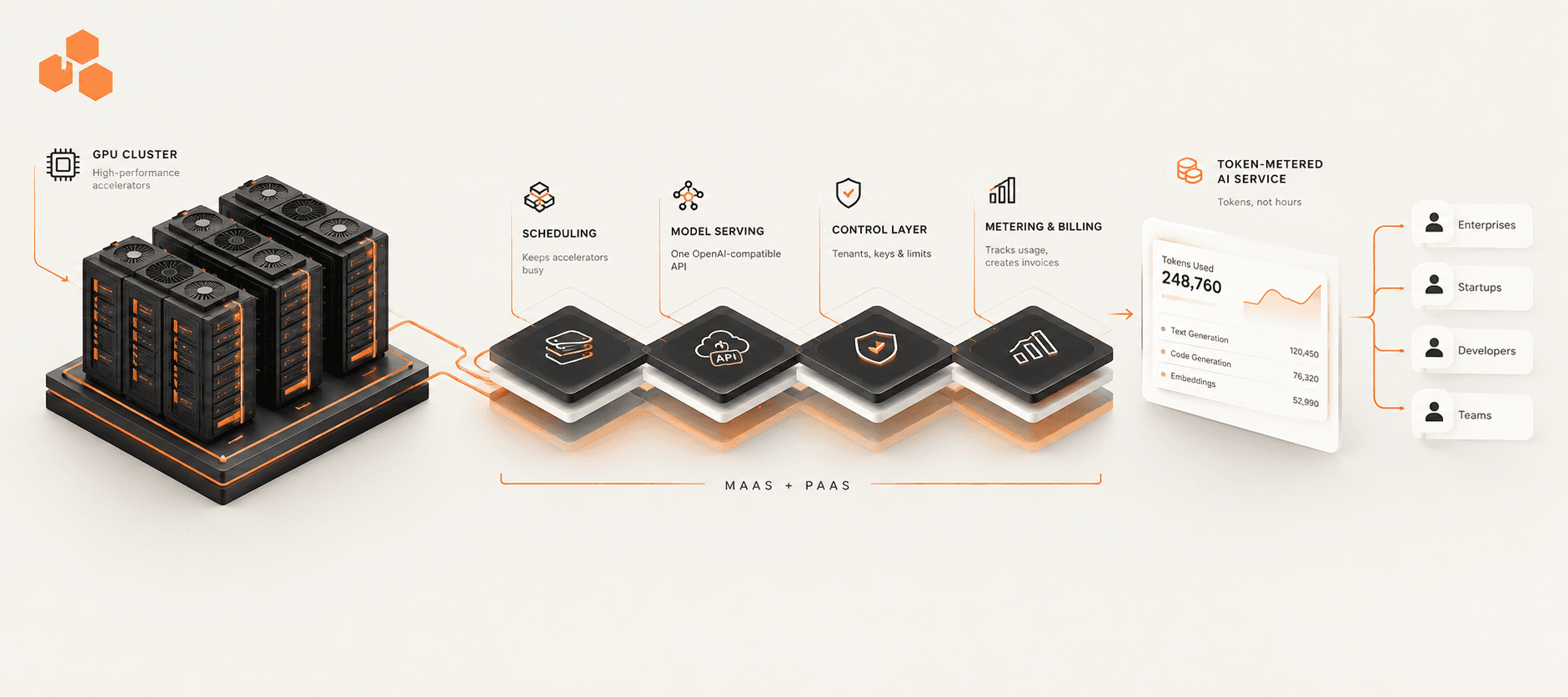
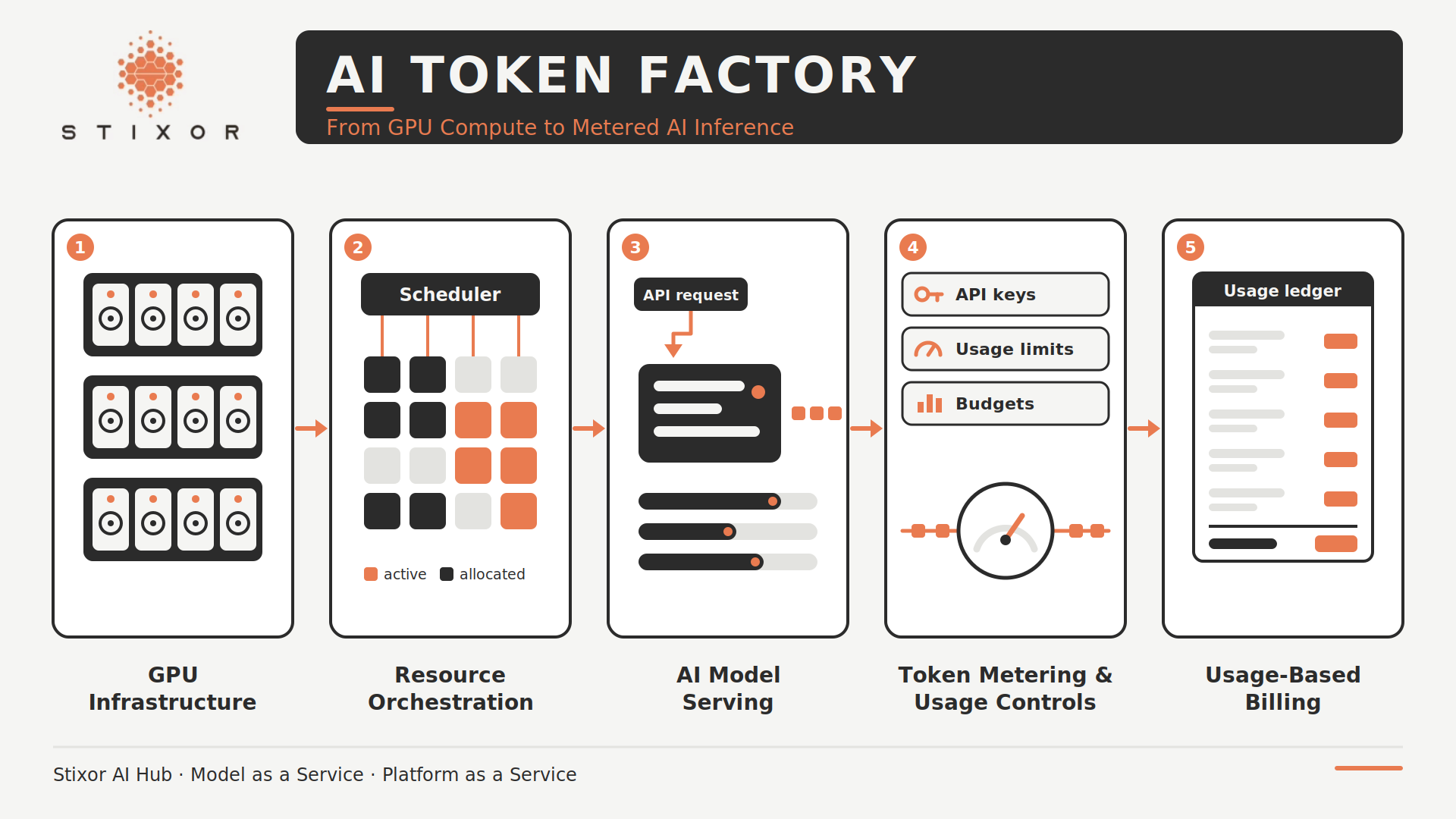
The implementation varies by platform, but four core functions connect computing resources to billable inference: scheduling, model serving, tenant controls, and metering with billing.
1. Scheduling and Accelerator Management
The infrastructure layer supplies the computing resources used for inference. A scheduler determines how workloads are placed and how available capacity is allocated.
Scheduling matters economically because an accelerator that is provisioned but underused still contributes to the operator's infrastructure costs.
Stixor AI Hub uses Kubernetes-based scheduling, accelerator slicing, priority tiers and spot backfill.
In practical terms:
- Accelerator slicing allows supported workloads to share accelerator resources where the hardware and configuration permit it.
- Priority tiers help determine which workloads receive resources first when capacity is constrained.
- Spot backfill uses available capacity for interruptible workloads when higher-priority work does not require it.
These mechanisms can improve resource utilization, but they do not guarantee that every accelerator will remain busy. Actual results depend on demand, model sizes, workload compatibility, scheduling policies and available capacity.
Stixor AI Hub supports nine accelerator families, including Huawei Ascend, NVIDIA and AMD. Operators still need to validate their intended models and serving software on the hardware they plan to use.
2. Model Serving Through an API
Customers generally want a reliable endpoint and a model they can call, not direct responsibility for the underlying hardware.
A Model as a Service layer places supported models behind an API. Applications send requests to the endpoint, and the serving environment routes them to the relevant model deployment.
Stixor AI Hub provides an OpenAI-compatible API for supported model access. This allows applications designed for that API format to connect with compatible deployments, subject to the models, endpoints and features available in the environment.
API compatibility does not mean every model or every API feature works identically across platforms. Operators should test their applications against the actual deployment.
3. Tenant Management, API Keys and Usage Limits
An operator serving multiple customers needs to distinguish each tenant's usage and permissions.
Tenant management establishes the customer or organizational unit using the service. API keys identify callers, while model entitlements determine which models they are allowed to access.
Rate limits control how frequently requests can be submitted or how much token traffic can pass through within a defined period.
Two common limits are:
- Requests per minute (RPM): limits the number of requests accepted over a time window.
- Tokens per minute (TPM): limits token throughput over a time window.
These controls help protect shared capacity from excessive traffic and make usage easier to manage across customers or internal teams.
Stixor AI Hub provides tenant and API key management, model entitlements, RPM and TPM limits, and namespace-level tenant separation. Namespace-level separation is one part of the deployment's isolation model; buyers with stricter security requirements should assess the complete configuration, including identity, networking, permissions, infrastructure and operational controls.
4. Token Metering and Billing
Metering records how much of the service each caller consumes. In a token factory, usage records can include input tokens, output tokens, model identifiers, tenant or key identifiers, timestamps and other fields supported by the platform.
Billing applies the relevant commercial rules to those records. These rules can include model-specific rates, billing periods, prepaid balances, account agreements and adjustments for eligible failures or retries.
Stixor AI Hub supports per-key token metering, prepaid and on-demand billing, and usage records that can feed invoicing.
This distinction matters because metered usage is not automatically the same as billed revenue. Operators need to reconcile usage records against pricing rules, billing adjustments and invoices to identify discrepancies and understand the economics of the service.
For an internal enterprise platform, the same records can support cost allocation:
- Chargeback assigns consumption costs to the responsible department or business unit.
- Showback reports consumption and associated costs without transferring money between internal teams.
An operator selling inference to external customers and an enterprise sharing a cluster internally may use similar controls, even though their commercial processes differ.
An Additional Layer: Model Development and Fine-Tuning
Some AI infrastructure platforms extend beyond serving existing models. They also provide tools to prepare, fine-tune, evaluate and deploy models.
Stixor AI Hub's PaaS capabilities include hosted Jupyter notebooks, bring-your-own-container workflows, LoRA and QLoRA, full fine-tuning workflows, no-code tuning, experiment tracking and a model registry with deployment capabilities.
These functions expand the platform's role beyond token-metered inference. They support model-development workflows, while the MaaS layer focuses on providing model access through managed endpoints.
Not every token factory needs to offer model training. An operator focused exclusively on inference can keep its platform simpler and concentrate on model serving, usage controls, reliability and billing.
For the broader architecture, see How Stixor AI Hub Works.
What Happens Between an API Request and a Billable Record?
A typical request passes through several controls before the model generates a response. The precise sequence depends on the platform implementation, but the general workflow is straightforward.
- Authentication: The API key identifies the caller and its associated tenant.
- Authorization: The platform checks whether that tenant is permitted to access the requested model.
- Rate limiting: RPM and TPM policies determine whether the request can proceed within the applicable limits.
- Budget enforcement: Applicable spending limits or prepaid balance rules are checked before inference.
- Execution: The request reaches the model-serving environment and uses the required computing resources.
- Metering: The platform records the applicable input and output token usage.
- Billing reconciliation: Usage records are processed under the service's pricing and billing rules.
- Reporting: The resulting records feed customer invoices, account usage reports or internal chargeback and showback.
The important distinction is between controlling a request before execution and recording its consumption afterward.
Stixor AI Hub enforces its configured budget caps before a request reaches the model. This helps prevent requests that would exceed the applicable limits from being served, subject to the platform's configured rules.
A well-designed metering process should also define how it handles retries, failed requests, cancelled requests and other exceptional cases. The billing policy needs to match the records generated by the system so that operators can explain what was charged and why.
Why Must Budgets Be Enforced Before Inference?
A spending limit is most useful when it prevents additional usage rather than merely reporting an overrun afterward.
For example, a misconfigured application or compromised API key could repeatedly call a model. If the platform only checks the total during invoice preparation, the excess consumption may already have occurred.
Budget enforcement can reduce this risk by checking the applicable limits before allowing a request to proceed.
Stixor AI Hub supports team budget caps and administrator-enforced hard caps that tenants cannot exceed. The configured controls are checked at the API before the request reaches the model.
- Rate limits and budget caps serve different purposes:
- Rate limits manage traffic over short periods and help protect shared capacity.
- Budget caps constrain spending over a defined billing period or account balance.
- Usage alerts notify administrators when consumption approaches a threshold, where configured.
Prepaid billing can make spending limits easier to manage because available balance constrains future consumption. On-demand billing still requires clear budget policies, monitoring and enforcement.
Operators should test limits with concurrent requests and realistic workloads. They should also document what happens when a request would exceed a cap, including whether it is rejected, delayed or handled under a different policy.
Which Metrics Show Whether an AI Token Factory Is Profitable?
Token count alone cannot tell an operator whether a service is performing well. The platform needs to measure infrastructure efficiency, user experience, cost and the relationship between metered usage and billed revenue.
Throughput per Accelerator
Throughput measures how many tokens the serving environment generates over time. Measuring it per accelerator helps operators compare workloads and configurations, provided they use consistent testing conditions.
Throughput varies with the model, input and output lengths, batch size, concurrency, serving software and hardware configuration.
Performance per Watt
Performance per watt measures how much inference throughput the system produces relative to its power consumption.
NVIDIA emphasizes tokens per second per watt and facility-level efficiency in its discussion of token factories. For an operator, power efficiency matters because energy contributes to the cost of operating infrastructure.
However, better performance per watt does not automatically guarantee higher profit. Pricing, utilization, infrastructure costs, service quality and customer demand also affect the outcome.
Accelerator Utilization
Utilization helps show how much of the available computing capacity is being used.
Low utilization can indicate insufficient demand, inefficient scheduling, poorly matched capacity or workloads that do not keep the accelerators busy. High utilization can improve the economics of a service, but it must be balanced against latency, queueing and reliability requirements.
Cost per Million Tokens
Cost per million tokens estimates the cost of serving a defined volume of tokens.
Operators should establish which costs they include. Depending on the purpose of the calculation, these may include accelerator infrastructure, electricity, hosting, storage, networking, model-serving software and operational overhead.
Input and output tokens may have different serving costs, so a single blended figure should be interpreted in the context of the workload mix.
Time to First Token and End-to-End Latency
Time to first token measures how long a user waits before the model begins returning generated output. End-to-end latency measures the total time taken to complete the request.
These metrics matter for interactive applications such as assistants and conversational interfaces. High throughput is useful, but it does not compensate for a poor user experience if requests take too long to begin or finish.
Metered-to-Invoiced Reconciliation
Operators should reconcile recorded usage with the amounts that enter invoices or internal cost reports.
Differences can arise from pricing rules, adjustments, retries, failed requests, billing periods or processing errors. The goal is not necessarily to make every raw token record map one-to-one to an invoice line; it is to explain every material difference.
Operators should also monitor authentication failures, rejected requests, rate-limit events and unusual usage patterns. These records help identify operational problems and investigate unexpected consumption.
Together, these metrics show whether the factory is producing inference efficiently, meeting user expectations and converting usage into accurately accounted-for revenue.
When Should You Avoid Building an AI Token Factory?
A token factory is not the right choice for every infrastructure operator.
First, avoid building one solely because the term is popular. The model requires a real demand for managed inference, a suitable serving environment and a commercial reason to offer tokens rather than only hardware capacity.
Second, a small number of customers that each require dedicated hardware may be better served through reserved capacity or GPU rental. A token-based model can leave the operator carrying idle-capacity risk if customer demand is inconsistent.
Third, organizations that mainly run long training jobs or highly customized workloads may need a different service model. Token-metered inference is designed around requests to deployed models, not every possible use of a GPU cluster.
Finally, a company that only consumes an external AI provider's API generally does not need to operate a token factory itself. It needs to manage its own API usage, budgets and provider costs instead.
Before investing, estimate demand, model mix, expected concurrency, service-level requirements, infrastructure costs and pricing. Test the economics under both high- and low-utilization scenarios.
One additional consideration is that tokens are not a universal unit of completed work. Token counts depend on the model's tokenizer, and different models can produce different counts for the same text. Buyers should compare cost per task and the quality of the result, not token counts alone.
What Should Pakistani Enterprises Consider?
For Pakistani enterprises, the location of inference and the treatment of business data can influence which service they can use.
Banks, public-sector organizations and other regulated buyers may have requirements relating to outsourcing, data classification, access controls and the location of processing. Those requirements depend on the organization, workload, service arrangement and applicable rules.
Banking and Financial Services
The State Bank of Pakistan's BPRD Circular No. 01 of 2023 sets out a framework for outsourcing to cloud service providers by SBP-regulated entities. It takes a risk-based approach to cloud outsourcing and distinguishes between different arrangements and workloads.
A bank considering a hosted model API should assess the service against its applicable outsourcing requirements, risk assessment, contractual obligations and internal policies. Whether a particular service arrangement triggers specific approval or other obligations depends on the circumstances and should be determined by the bank's compliance and legal teams.
Public-Sector Data
Pakistan's Cloud First Policy and related cloud-service accreditation criteria address government cloud adoption and data classification. The applicable requirements can depend on the class of data and the relevant public-sector entity.
Official policy material is available through the Ministry of Information Technology and Telecommunication. Buyers should consult the current policy and accreditation documents rather than relying solely on summaries or assumptions about where a service is hosted.
Questions Buyers Should Ask
Before using a token-metered AI service, enterprises should establish:
- Where are prompts processed, and where are model workloads hosted?
- What information is retained in request logs and usage records?
- Who can access prompts, outputs, logs and administrative functions?
- How are tenant permissions and API keys managed?
- Can usage be monitored and spending limits enforced?
- What contractual, regulatory and data-handling obligations apply to the deployment?
An in-country deployment can help address data-location requirements where applicable, but location alone does not establish compliance. The buyer must assess the complete service and its operating arrangements.
For more context on local inference infrastructure, see AI Inference in Pakistan.
What Should Operators Consider in Saudi Arabia and the Gulf?
Organizations serving customers in Saudi Arabia and the wider Gulf should assess data processing, hosting location, contractual commitments and applicable local requirements before choosing a deployment model.
Saudi Arabia's Personal Data Protection Law (PDPL) came into force on 14 September 2023 and became fully enforceable on 14 September 2024. The law and its implementing regulations address the processing of personal data, including relevant cross-border transfers.
Official information is available from the Saudi Data and AI Authority (SDAIA). The applicability of the law and transfer requirements depends on the data, parties and processing arrangements involved.
For a token factory, buyers should understand where requests are processed, whether prompts contain personal data, which parties can access the information, and whether data is transferred outside the Kingdom.
Stixor AI Hub can be deployed inside a customer's own data center or cloud environment, supporting deployment choices where customers require control over their infrastructure. That flexibility does not automatically establish compliance; the customer and provider must assess the actual deployment and data flows against applicable requirements.
Arabic-language workloads also deserve practical testing. Token counts depend on the model's tokenizer and the text being processed, so operators should benchmark their actual Arabic prompts and outputs before setting usage budgets or estimating costs.
Does an AI Token Factory Depend on One Accelerator Vendor?
No. An AI token factory is an operating and commercial model, not a requirement to use one particular accelerator vendor.
However, the hardware and software environment affects which models can be deployed and how efficiently they run. Model-serving frameworks, drivers, libraries and accelerator-specific software stacks may differ across hardware platforms.
For example, NVIDIA-based environments commonly use the CUDA software ecosystem, while Huawei Ascend deployments use Huawei's CANN stack. A model or serving tool that works well in one environment may require adaptation or additional validation in another.
Stixor AI Hub supports nine accelerator families, including Huawei Ascend, NVIDIA and AMD. This gives operators options across supported hardware environments, but compatibility should be validated for the intended models and configurations.
Before selecting infrastructure, test:
- Model availability and compatibility.
- Serving framework and software requirements.
- Tokens per second under realistic traffic.
- Time to first token and end-to-end latency.
- Cost per million tokens under expected utilization.
- Operational requirements for monitoring, upgrades and troubleshooting.
Benchmark results from another provider or hardware configuration should not be treated as a guarantee of your own results.
How Does Stixor AI Hub Fit into an AI Token Factory?
Stixor AI Hub provides the software layer between computing infrastructure, model-serving environments and the applications that consume inference.
Its MaaS layer provides model access through an OpenAI-compatible API, with tenant management, API keys, model entitlements, RPM and TPM limits, budget enforcement, token metering and usage records that can support billing.
Its PaaS capabilities extend to model-development workflows, including hosted notebooks, training and fine-tuning options, experiment tracking and model deployment workflows.
The platform also supports Kubernetes-based scheduling, accelerator slicing, priority tiers and spot backfill across nine accelerator families, including Huawei Ascend, NVIDIA and AMD.
Stixor AI Hub is software, not a physical GPU, a data center or an AI model. It does not remove the need to select suitable infrastructure, validate model compatibility, configure deployment security or establish a viable commercial model.
It is relevant to two groups:
- Infrastructure operators that want to deliver managed, token-metered inference alongside other computing services.
- Enterprises that want to provide shared model access to internal teams, manage consumption and allocate costs across business units.
Organizations that only need dedicated computing capacity may prefer GPU rental. Organizations that only consume an external provider's API may need usage governance rather than a token factory of their own.
For the technical architecture, read How Stixor AI Hub Works. For product capabilities, visit the Stixor AI Hub product page.

Turn your GPU cluster into a billable AI service.
Stixor AI Hub gives you the control layer between your accelerators and your customers: one OpenAI-compatible API, tenants and keys, budgets checked before the call, and per-key token metering with invoiceable usage records.
Frequently Asked Questions
FAQs
An AI token factory is an AI infrastructure environment that delivers model inference through an API and measures consumption in tokens. It combines computing resources, model serving, access controls, usage limits and metering to provide a managed service.
Not exactly. The terms are related but can emphasize different parts of the system. AI factory often refers to the broader infrastructure and operational environment used to produce AI workloads. AI token factory emphasizes inference delivered and measured as tokens. Usage varies across the industry, and neither term defines a single mandatory architecture.
No. GPU rental gives customers access to computing capacity, while token-metered inference gives them access to a managed model service. Operators can offer both, depending on customer requirements and their business model.
Not directly. Token counts depend on the tokenizer and model, and the same text can produce different token counts across models. Compare cost per completed task and the quality of the result, using representative workloads.
No. The operating model can use different supported accelerators. Hardware choice affects software compatibility, performance, availability and operating costs, so operators should test their intended models on their planned infrastructure.


Discuss Your Enterprise Use Case
From small to large scale enterprises, we deliver next-gen AI, data engineering, and actionable insights.


