
Predictive Maintenance in Manufacturing

Written by Muhammad Rizwan
March 4, 2025
11 min Read
Predictive maintenance in manufacturing uses data from machines (vibration, temperature, current, pressure, oil quality) to spot early signs of failure and fix equipment just before it breaks. Instead of repairing machines after they stop or servicing them on a fixed calendar, teams act on the machine's actual condition. Done well, it cuts unplanned downtime, avoids unnecessary parts changes and makes maintenance work plannable.
This guide explains how predictive maintenance works, which machines it suits, what results plants actually see, where it goes wrong, and how to run a first project in 90 days.
Definition: Predictive maintenance (PdM) is a maintenance strategy that monitors the condition of equipment with sensors and data, uses analytics or machine learning to estimate when a component is likely to fail, and schedules repair before that point. Its goal is to fix the right asset at the right time, not too early and not too late.
Key takeaways
- Unplanned downtime is expensive. Siemens estimates it costs the world's 500 biggest companies 11% of revenue, about $1.4 trillion a year (2024).
- In a NIST survey of US manufacturers, plants that leaned most on predictive maintenance reported 15% less downtime and an 87% lower defect rate than peers.
- Start with a few critical, failure-prone machines that already produce data, not the whole plant.
- Simple condition monitoring with good thresholds often beats a complex model built on poor data.
- False alarms are the main reason programs stall. Measure precision, not just accuracy.
- A first pilot can run in about 90 days if data access and a maintenance owner are agreed up front.
What Is Predictive Maintenance in Manufacturing?
Predictive maintenance is condition-based repair timed by data: you watch how a machine behaves and intervene when the data shows it is heading toward failure.
Most plants use a mix of three maintenance approaches:
Reactive maintenance: run equipment until it breaks, then fix it. Cheap to plan, expensive when a critical line stops.
Preventive maintenance: service equipment on a schedule (every 500 hours, every quarter). Predictable, but parts are often replaced while they still have useful life, and failures between services still happen.
Predictive maintenance: monitor condition continuously or at short intervals and act only when the data shows degradation. It needs sensors, data pipelines and analysis, but it targets effort where it is needed.
The core idea behind predictive maintenance is the P–F interval: the time between the point (P) where a developing fault becomes detectable and the point (F) where the asset functionally fails. Vibration from a worn bearing, for example, often appears weeks before the bearing seizes. The longer and more reliable that window, the more value predictive maintenance can deliver.
Why Are Manufacturers Investing in Predictive Maintenance Now?
Because downtime has become more expensive, sensors and data platforms have become cheaper, and the results are now measured rather than assumed.
Siemens' True Cost of Downtime 2024 report puts unplanned downtime at 11% of revenue for the world's 500 largest companies, about $1.4 trillion a year. The same report estimates a lost hour at $2.3 million in automotive and $36,000 in fast-moving consumer goods. It also found that nine in ten respondents already run some form of condition monitoring and almost half have dedicated predictive maintenance teams.
Independent research points the same way. A NIST survey of US manufacturers (NIST AMS 100-34, 2020) found that establishments relying most on predictive maintenance had 15% less downtime, an 87% lower defect rate and 66% fewer inventory increases caused by maintenance problems. Plants that relied most on reactive maintenance had 3.3 times more downtime and 16 times more defects than those relying on it least. NIST estimated $119.1 billion a year in preventable losses from maintenance issues in US discrete manufacturing.
Two cautions. These figures describe associations across many plants, not a guaranteed result for one site. And the bigger savings claims that circulate online (50% to 90% fewer breakdowns) usually come from vendor marketing without a published method. Plan on your own baseline, not on headline numbers.
How Does Predictive Maintenance Work?
A predictive maintenance system turns machine signals into a maintenance decision through five steps: sense, collect, analyze, alert and act.
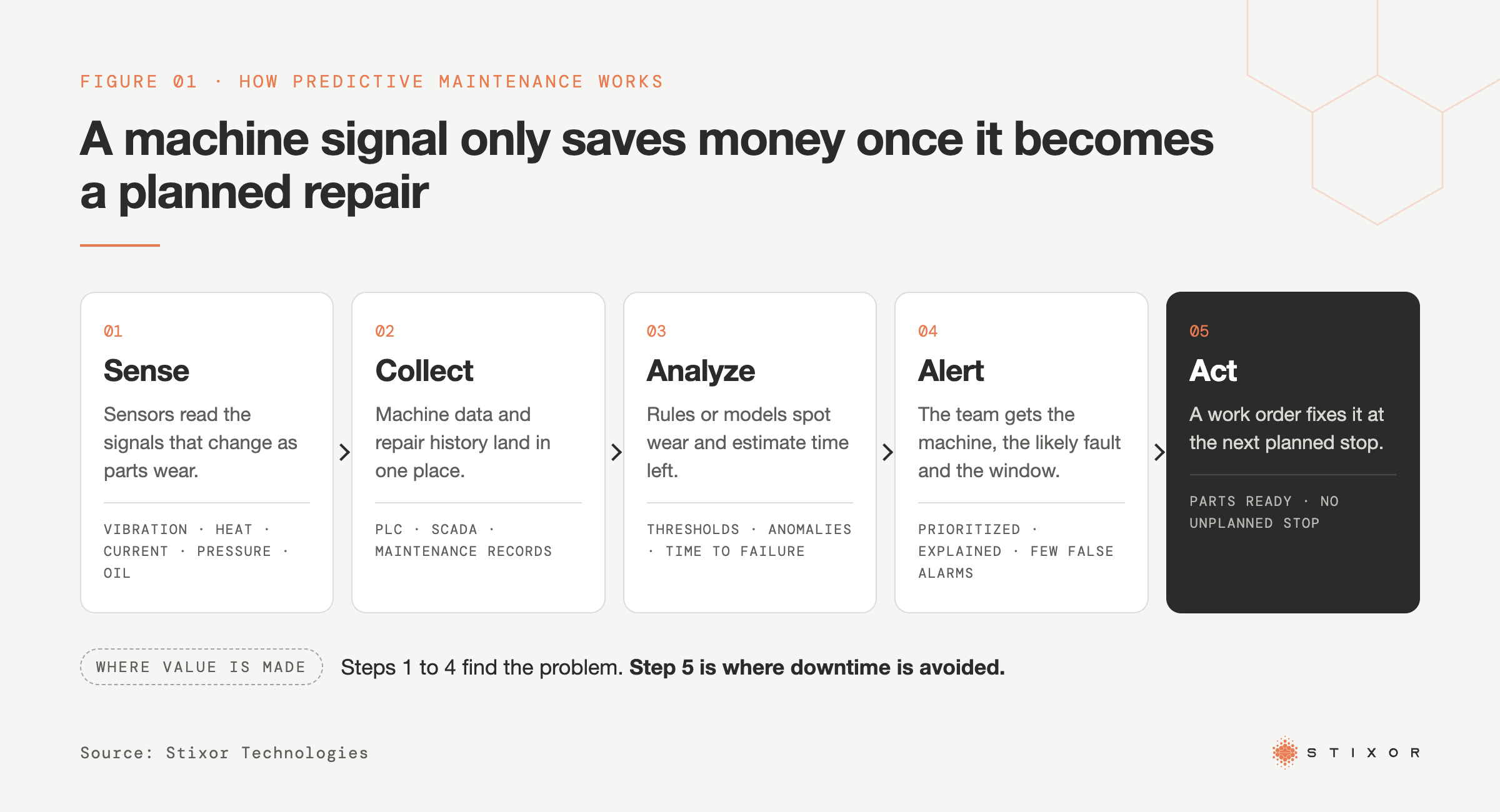
1. Sense. Sensors measure the signals that change as a component degrades: vibration (bearings, gearboxes, fans), temperature (motors, electrical panels), motor current (pumps, conveyors), pressure and flow (hydraulics, compressors), oil quality (gearboxes, engines) and acoustics (leaks). Many modern machines already expose this data through their controllers (PLCs) and SCADA systems.
2. Collect. Data is gathered at the edge (close to the machine) and moved to a central store. Plants often use OPC UA or MQTT, common industrial data protocols, to pull data from different equipment brands into one place. Maintenance records from the CMMS (computerized maintenance management system) are just as important, because they tell the model when failures actually happened.
3. Analyze. Analysis ranges from simple to advanced:
- Thresholds and rules: alert when vibration or temperature crosses a set limit. Easy to explain and often enough.
- Anomaly detection: learn what "normal" looks like for each machine and flag unusual behavior, useful when there are few recorded failures.
- Remaining useful life (RUL) models: estimate how many hours or cycles a component has left. These need failure history or physics knowledge. A 2024 survey in Sensors reviews the deep learning methods used for RUL and the problem of limited labeled failure data.
4. Alert. The system raises a prioritized alert with the asset, the likely fault and the time window, not just a red light on a dashboard.
5. Act. The alert becomes a work order in the CMMS, planned into the next convenient stop with the right parts on hand. This step is where value is created. A prediction nobody acts on saves nothing.
The international standard ISO 17359 sets out general guidelines for condition monitoring programs, which is a useful checklist for the sense-to-act chain.
What Are the Main Predictive Maintenance Use Cases in Manufacturing?
The strongest use cases are rotating and electrical equipment whose failures are expensive and show early warning signs in vibration, temperature or current.
Motors and pumps: rising vibration and current draw reveal bearing wear, misalignment and imbalance weeks ahead. Typical in food and beverage, chemicals and water treatment.
Gearboxes and conveyors: vibration and oil analysis catch gear tooth wear and lubrication problems before a line stops. Common in packaging, mining and logistics hubs.
CNC spindles and machine tools: spindle vibration, temperature and load trends predict bearing failure and tool wear, protecting both the machine and part quality.
Compressors and HVAC: pressure, temperature and power trends show leaks and fouling. Compressed air leaks also waste energy, so detection pays twice.
Injection molding and presses: hydraulic pressure and cycle-time drift show seal and valve wear before scrap rates rise.
Electrical panels and transformers: thermal imaging and current monitoring reveal loose connections and overheating, which are also safety risks.
Industrial robots: joint torque and motor current trends flag gearbox and reducer wear, important in automotive and electronics assembly.
Quality-linked maintenance: in many plants, quality drifts before machines fail. Linking process data (temperatures, pressures, cycle times) to defect rates lets teams fix equipment because scrap is rising, not only because a sensor crossed a limit.
Which Machines Should You Start With?
Start with the few assets where failure is costly, frequent enough to learn from, detectable in advance and already producing data.
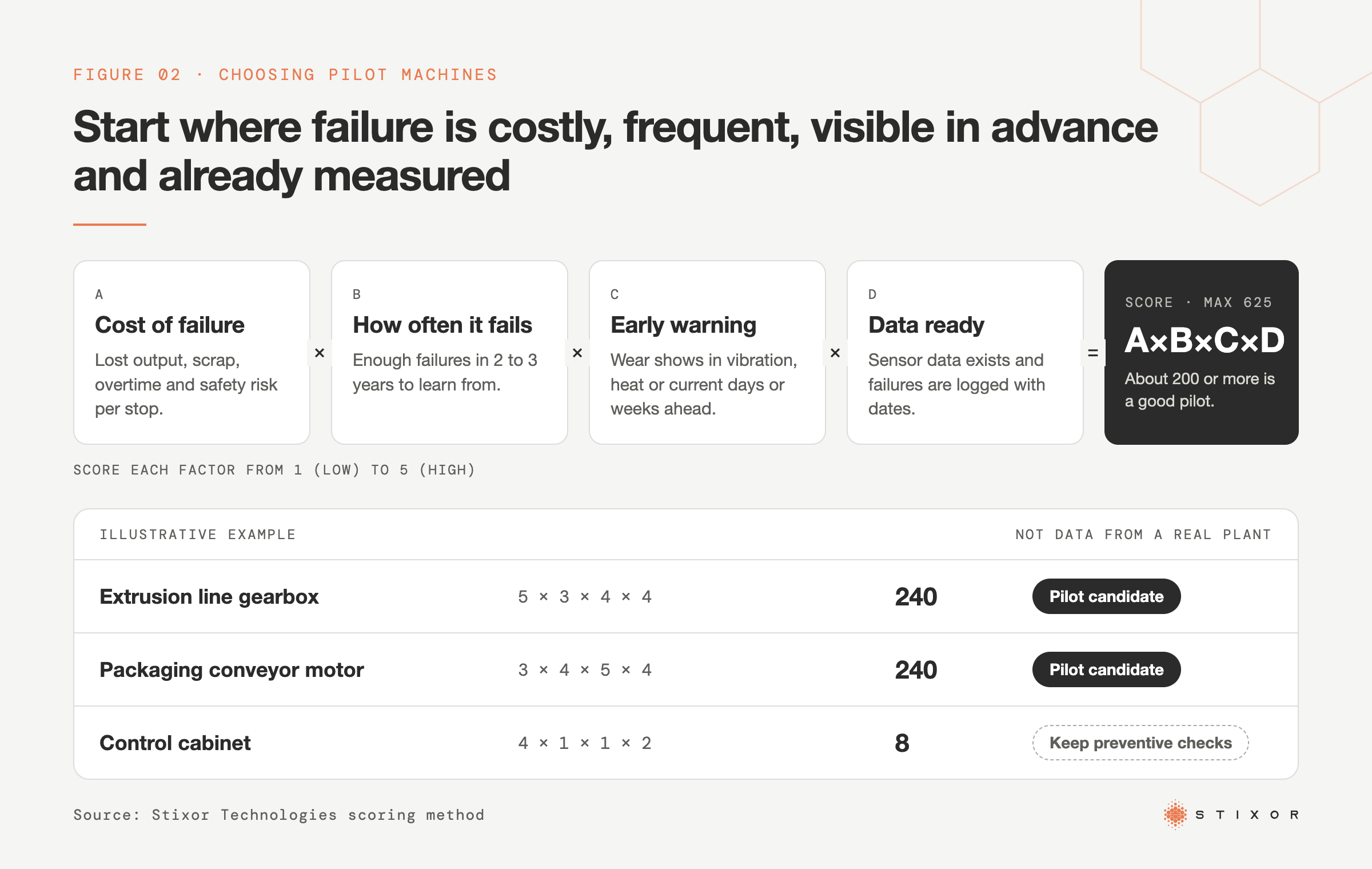
Most failed programs tried to cover the whole plant at once. A simpler approach is to score each candidate asset from 1 (low) to 5 (high) on four questions:
Cost of failure: how much does one unplanned stop cost in lost output, scrap, overtime and safety risk?
Failure frequency: has this asset or asset type failed often enough in the last two to three years to learn from?
Detectability: does the failure give warning signs (vibration, heat, current) days or weeks ahead, with a usable P–F interval?
Data readiness: is there already sensor or controller data, and are failures recorded in the CMMS with dates and causes?
Multiply the four scores. Assets scoring about 200 or more out of 625 are good pilot candidates. Assets with a high cost of failure but low detectability (for example, sudden electronic faults) are better handled with redundancy or spares than with prediction.
Illustrative example: a plant scores its main extrusion line gearbox at 5 × 3 × 4 × 4 = 240 and a packaging conveyor motor at 3 × 4 × 5 × 4 = 240. Both are reasonable pilots. A control cabinet that rarely fails and gives no warning scores 4 × 1 × 1 × 2 = 8, so it stays on preventive checks.
What Results Can Manufacturers Realistically Expect?
Expect fewer unplanned stops, better-planned maintenance work and longer component life, with savings that grow as data and processes mature.
Realistic outcomes in the first year usually include:
- fewer emergency repairs on the monitored assets
- maintenance work moved into planned stops, with parts ordered in advance
- fewer premature part replacements compared with fixed schedules
- clearer evidence for capital decisions, such as which machines to refurbish or replace
The NIST findings (15% less downtime, 87% lower defect rate among the heaviest predictive maintenance users) are a sensible reference point for a mature program. Treat any single-number promise with caution until you measure your own baseline: current downtime hours per asset, mean time between failures (MTBF) and maintenance cost per unit produced.
What Are the Common Challenges and How Do You Avoid Them?
Most predictive maintenance programs struggle for organizational reasons, not algorithmic ones: poor data, too many false alarms and no clear owner for acting on alerts.
Missing failure history: models need examples of failures. If the CMMS records "fixed pump" without a date or cause, fix the recording process first, and start with anomaly detection, which needs less failure data.
False alarms: a model that cries wolf is ignored within weeks. Track precision (how many alerts were real) and set thresholds with the maintenance team. One reliable alert a month beats ten doubtful ones a day.
Data silos: machine data, maintenance records and production data often live in different systems. Plan the data integration before the modeling.
Legacy equipment: older machines may need retrofit sensors. Wireless vibration and temperature sensors make this cheaper than it used to be.
Security and connectivity: connecting operational technology (OT) networks to IT systems raises cyber risk. Keep data flows one-way where possible and involve the OT security owner early. Some plants prefer on-premise processing so production data never leaves the site.
Skills and trust: technicians need to see why an alert fired. Explainable alerts ("vibration at 1x running speed up 40% in two weeks, likely imbalance") build trust faster than a black-box score.
How Do You Implement Predictive Maintenance in 90 Days?
Run a focused pilot: pick two to five assets, connect their data, build simple models first, and prove value through work orders, not dashboards.
Weeks 1–2: scope and baseline. Score candidate assets, pick two to five, agree the business owner, and record the baseline (downtime hours, failures, maintenance cost).
Weeks 3–5: data. Connect sensor or controller data, add retrofit sensors where needed, and clean maintenance records for the chosen assets.
Weeks 6–9: models and alerts. Start with thresholds and anomaly detection. Add remaining useful life models only where failure history supports them. Agree alert rules with technicians.
Weeks 10–12: act and measure. Route alerts into the CMMS as work orders, track every alert as confirmed or false, and compare against the baseline. Decide whether to scale to the next group of assets.
How Stixor Helps with Predictive Maintenance
Stixor builds AI and data platforms for industrial operators, including predictive maintenance, production monitoring and process optimization, deployed in the cloud or on-premise.
Stixor's manufacturing work covers the full chain this guide describes: connecting machine and process data, building data pipelines, developing predictive models, and putting them into production with monitoring (MLOps, the practice of running machine learning models reliably in production). See AI solutions for manufacturing.
The same predictive approach applies beyond the factory floor. For Mari Energies, a gas producer, Stixor built a reservoir intelligence platform that forecasts when gas wells will start producing water, using data the operator already collected and validated against its own historical records.
Who it suits: manufacturers and industrial operators with critical equipment, existing machine or maintenance data, and a team ready to act on alerts. If you only need basic vibration alarms on a handful of motors, an off-the-shelf condition monitoring kit may be enough.
Related services: data engineering and architecture, MLOps implementation, and on-premise deployments and security.
Related reading: Custom AI vs Off-the-Shelf AI.
Where to Start
Pick the three machines whose failure hurts most, check whether they give warning signs, and find out what data you already have. That short list is your pilot. For help scoring assets or connecting plant data, see Stixor's AI solutions for manufacturing.

Planning a predictive maintenance pilot?
Stixor helps manufacturers pick the right first machines, connect the plant data they already have, and turn early warnings into planned repairs, in the cloud or on-premise.
Frequently Asked Questions
FAQs
Preventive maintenance follows a fixed schedule, such as servicing a pump every 1,000 hours, whether it needs it or not. Predictive maintenance acts on the machine's measured condition, so work happens when the data shows wear. Preventive is simpler to run; predictive avoids both unexpected failures and unnecessary part changes. Most plants use both.
You need condition data from the machine (vibration, temperature, current, pressure or oil quality, depending on the failure) and maintenance history that records when and why failures happened. Production context, such as load, speed and product type, improves accuracy. Many plants already have useful data in PLCs, SCADA historians and their CMMS.
No. Mid-size plants often see faster payback because a single critical machine can stop the whole line. Wireless sensors and cloud or on-premise analytics have lowered the entry cost. The key is to start with a few high-impact assets rather than instrumenting everything.
Not always. Many early wins come from well-set thresholds and trend analysis. Machine learning adds value when signals interact in complex ways, when you want to estimate remaining useful life, or when you monitor many similar assets. Start simple and add models where the data justifies them.
Accuracy depends on the failure mode, sensor placement and data quality. Gradual mechanical wear, such as bearings, is usually easier to predict than sudden electronic faults. Judge a system by its precision (how many alerts were real) and by how much warning it gives, not by a single accuracy percentage.
A focused pilot on two to five assets can show results in about three months, mostly through avoided failures and better-planned work. Larger savings come in the second year, once the program covers more assets and maintenance planning changes around the alerts.
Predictive maintenance is one of the most practical Industry 4.0 applications. It uses connected sensors (the industrial internet of things, or IIoT), data platforms and analytics to improve a daily operational decision: when to service a machine. It is often the first project that proves the value of plant data.


Discuss Your Enterprise Use Case
From small to large scale enterprises, we deliver next-gen AI, data engineering, and actionable insights.


