
Custom AI vs. Off-the-Shelf Tools: What’s Right for Your Business in 2025?

Written by Muhammad Rizwan
April 17, 2025
8 min Read
Buy off-the-shelf AI when the task is common and the tool already does it well; build custom AI when the task is specific to your business, uses data no vendor can see, or gives you an edge competitors can't buy. Most companies end up with both: off-the-shelf tools for everyday work, and a few custom systems where the value is highest.
Definition: Off-the-shelf AI is a ready-made AI product or API that you buy or subscribe to and use as it is, such as a writing assistant, a chatbot builder or a hosted language model. Custom AI is a system built or adapted for your specific data, workflow and goals, using your own models or models you fine-tune and integrate.
Key takeaways
- Off-the-shelf AI is fast and cheap to start, but you share the same features as everyone else and depend on the vendor.
- Custom AI costs more up front, but can use your own data, fit your process and keep data inside your environment.
- MIT's 2025 study found that buying from specialized vendors succeeded about 67% of the time, while internal builds succeeded about a third as often.
- A third option, a platform you control that runs ready models, often gives the best of both.
- Decide use case by use case, not once for the whole company.
What Is Off-the-Shelf AI?
Off-the-shelf AI is software you can switch on and use without building a model: you configure it, connect it, and pay a subscription or per-use fee.
Common examples include AI writing and meeting assistants, customer-service chatbots, document scanning tools, and hosted large language model APIs. They work well because the vendor has already solved the general problem for many customers.
Strengths: fast to start (days or weeks), low upfront cost, vendor handles updates and hosting.
Limits: generic behavior, limited control over how the model works, data may leave your environment, pricing can rise as usage grows, and switching vendors later can be hard.
What Is Custom AI?
Custom AI is built around your data and process: a model, workflow or agent designed for a job only your business does in exactly that way.
Examples include fraud scoring trained on your transaction history, demand forecasting for your branches, or an assistant that answers from your internal documents with your access rules. Custom does not always mean training a model from scratch. Most custom AI today combines existing models with your data, integrations and controls.
Strengths: fits your workflow, uses proprietary data, keeps data in your environment, and can become a real competitive advantage.
Limits: higher upfront cost, longer time to value, and you need people to run and improve it.
Custom vs Off-the-Shelf AI: How Do They Compare?
Off-the-shelf wins on speed and starting cost; custom wins on fit, data control and long-term advantage.
Time to value: off-the-shelf in days to weeks; custom usually takes months, depending on data and integration work.
Upfront cost: off-the-shelf is low (subscription or usage fees); custom needs investment in engineering, data and infrastructure.
Running cost: off-the-shelf costs grow with users and usage; custom costs are more predictable once built, but include hosting and maintenance.
Fit: off-the-shelf covers common needs; custom covers your exact process and edge cases.
Data control: off-the-shelf often processes data on the vendor's servers; custom can run fully inside your data center or cloud.
Competitive edge: off-the-shelf gives you what competitors also have; custom can create something they can't buy.
What Does the Research Say About Building vs Buying AI?
Buying is more likely to succeed when the problem is common; building pays off when you have the data, people and a clear business case.
MIT's NANDA initiative studied 300 public AI deployments, interviewed 150 leaders and surveyed 350 employees for The GenAI Divide: State of AI in Business 2025. According to Fortune's coverage of the report, purchasing AI tools from specialized vendors and building partnerships succeeded about 67% of the time, while internal builds succeeded only about a third as often. The same coverage reports that only about 5% of AI pilot programs achieved rapid revenue acceleration.
The lesson is not "never build." It is that custom projects need a narrow, valuable use case, good data and an owner in the business, or they stall as pilots.
When Should You Choose Off-the-Shelf AI?
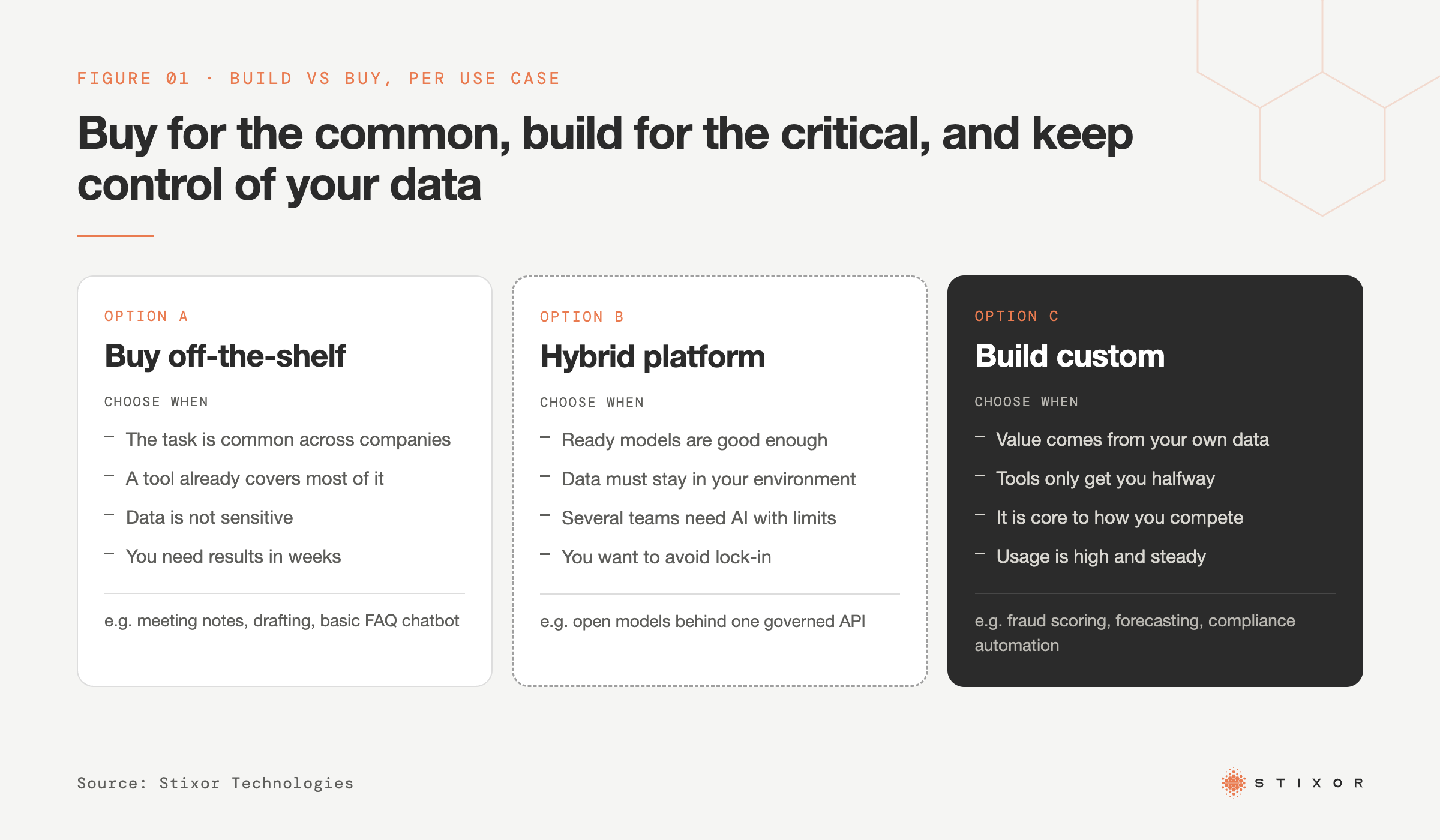
Choose off-the-shelf when the task is standard, the data is not sensitive, and speed matters more than differentiation.
- The task is common across companies (meeting notes, drafting, basic customer FAQs).
- A good tool already exists and fits 80% or more of your need.
- The data involved is not regulated or confidential.
- You want to test value quickly before investing more.
- You don't have an AI team to build and maintain a system.
When Should You Choose Custom AI?
Choose custom when the use case depends on your own data, has to fit a specific process, or must stay inside your environment.
- The value comes from proprietary data, such as transactions, sensor readings or internal documents.
- Off-the-shelf tools get you only halfway, and the gap is where the value is.
- Rules on data residency or privacy mean data can't go to a vendor's cloud.
- The system is core to how you compete, so you want to own and improve it.
- Usage is high and steady enough that owning the system costs less over time.
Is There a Middle Ground Between Custom and Off-the-Shelf?
Yes: run ready-made models on a platform you control, and customize only the parts that matter.
Many organizations now combine ready models (often open-weight models) with their own data, integrations and governance. This gives faster results than building from scratch while keeping control over data, cost and which models you use. It also avoids lock-in, because you can swap models without rebuilding the application. See How to Choose the Right Open-Source LLM for how to pick the models.
What Costs Should You Compare?
Compare the total cost over two to three years, not the first invoice.
Off-the-shelf: subscription or per-seat fees, usage-based charges, integration work, add-ons, and the cost of switching later.
Custom: design and engineering, data preparation, infrastructure or GPU time, monitoring, maintenance, and staff to improve the system.
For both, add the cost of the business process change: training staff, updating workflows and measuring results. Projects fail more often on adoption than on technology.
Real Examples of Custom AI in Business
Custom AI earns its cost when it solves a problem specific to one organization's data.
Real-time fraud detection: Stixor helped JazzCash build AI fraud detection that scores transactions in real time with graph analytics to uncover fraud rings. See the fraud detection case study.
Reservoir forecasting: for Mari Energies, Stixor built a platform that forecasts when gas wells will start producing water, using data the operator already had. See the water breakthrough case study.
Customs compliance: EMT.AI automates HS code classification, duty and VAT calculation and customs documents. See the customs automation case study.
No off-the-shelf tool could have used these organizations' own transaction, well or trade data in the same way.
How Stixor Helps You Decide
Stixor starts with the use case, not the technology: we help you decide what to buy, what to build, and how to connect them.
Stixor's AI and machine learning team assesses your use cases, data and constraints, recommends buy, build or hybrid for each, and then builds and runs the custom parts. See Enterprise AI & Machine Learning Solutions.
Who it suits: organizations with valuable data and at least one use case that off-the-shelf tools don't solve. If a standard tool already covers your need, buy it; you don't need a custom project.
Related reading: How to Choose the Right Open-Source LLM, Top AI Companies in Pakistan and AI in Regulated Industries: Lessons from Legal AI.
The Bottom Line
Buy for the common, build for the critical, and keep control of your data either way. List your top five AI use cases, mark each as common or specific to you, and you will have your build-vs-buy plan.

Not sure what to build and what to buy?
Stixor reviews your AI use cases, data and constraints, recommends buy, build or hybrid for each, and then builds the custom parts.
Frequently Asked Questions
FAQs
Off-the-shelf AI is a ready-made AI product or service you can use without building it, such as a chatbot builder, writing assistant or hosted language model API. You configure and connect it, but you don't control how the underlying model is built.
Neither is better in general. Off-the-shelf is better for common tasks where speed and low cost matter. Custom is better when the value depends on your own data, a specific process or keeping data inside your environment. Many businesses use both.
Off-the-shelf tools usually cost a subscription or usage fee, so they are cheaper to start. Custom AI needs upfront investment in engineering, data and infrastructure, but can cost less over time at high, steady usage. Compare total cost over two to three years.
Often, to a point. Many tools let you add your documents, adjust prompts or connect your systems. When you need deeper changes, such as fine-tuning a model, strict data residency or complex workflows, you usually need a custom or hybrid approach.
Buy one if you need a general FAQ or support bot and your data isn't sensitive. Build or customize one if it must answer from internal documents with access controls, work in local languages, or run inside your own environment.
Decide per use case. Ask whether the task is common, whether a tool already covers most of it, how sensitive the data is, and whether the use case is core to how you compete. Common and non-sensitive points to buy; specific and strategic points to build.


Discuss Your Enterprise Use Case
From small to large scale enterprises, we deliver next-gen AI, data engineering, and actionable insights.


