
Forecasting Water Breakthrough with a Reservoir Intelligence Platform
Our reservoir intelligence platform forecasts when a gas well will start producing water, and how much, years before it happens. Built entirely on data the operator already collects, it combines survival analysis, three-month early warning surveillance, and per-well volume forecasting, validated against Mari Energies own historical breakthrough records.

3–8%
production uplift
75%
breakthrough events caught years before
30–50%
reduction in facilities planning uncertainity
100%
audit trail coverage with ESG reporting
Business Overview and Strategic Direction
EXECUTIVE SUMMARY
Mari Energies, a major gas exploration and production operator, needed a better way to predict water breakthrough in a carbonate reservoir before it disrupted production and increased handling, treatment, disposal, and intervention costs. Conventional reservoir studies were too slow and infrequent for timely action.
Stixor developed a reservoir intelligence platform that uses existing production, completion, and petrophysical data to forecast breakthrough timing and water volumes. Validated against historical well data, the platform gives engineering teams months to years of lead time to plan workovers, prepare water handling capacity, and manage disposal requirements.
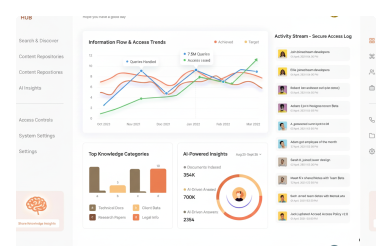
Operational Challenges in Gas Well Water Management
Forecasting water breakthrough on a carbonate reservoir demands long-horizon accuracy, honest uncertainty, and engineering trust. Key challenges:
PROBLEM STATEMENT
Late Discovery
Breakthrough was confirmed only after water volumes rose, leaving no lead time to plan a workover or size facilities.

Slow Simulation Cycles
Full reservoir simulation studies are expensive and rerun infrequently, so the operating picture ages every month.

No New Data Available
Any solution had to work from records already collected. New instrumentation or acquisition programmes were out of scope.
Engineering Trust
A forecast that fires false alarms, hides its misses, or implies false precision does not survive contact with a reservoir engineering team.
Three-Module Reservoir Intelligence Platform
One platform connects long term breakthrough forecasting, near term risk detection, and water volume planning, giving operators a clearer view of what is coming and time to act.
Our Solution
Long-Horizon Breakthrough Timing
Cox survival analysis, benchmarked against multiple statistical and ML models, forecasts breakthrough timing from geological and production data. P10/P50/P90 ranges give engineers a practical view of expected timing and uncertainty.
Three-Month Early Warning
The platform combines WGR trends, threshold momentum, next quarter WGR forecasts, and pressure decline through gradient boosting to identify wells approaching breakthrough with actionable three month lead time.
Water Volume Forecasting
Per well time series forecasting uses gas rate and wellhead pressure to estimate future water volumes. Monthly updates help operators plan water handling, treatment, disposal, and potential interventions.
01
01 Data Assessment and Definition
- Audit of existing production, completion, petrophysical, and water chemistry records
- Breakthrough threshold and labelling rules agreed with the operator's reservoir engineers
- Feature engineering reviewed against reservoir physics, not selected on statistics alone
02
02 Model Development and Selection
- Approximately 100 modelling configurations evaluated across feature sets, model families, and label definitions
- Spud and live model modes built to serve day-one planning and mature-well surveillance
- Retraining on the enhanced dataset brought average timing error to 1.4 years
03
03 Validation and Handover
- Leave-one-well-out cross-validation: every prediction came from a model that never saw that well
- Blind test on four wells with water data withheld until forecasts were locked
- Platform handed over with documented methodology, ranked drivers, and a production roadmap
Validated Outcomes Across the Full Well Cohort
IMPACT & RESULTS
Prediction Performance
11 of 13
Event Wells Within P10–P90 Range
75%
Breakthroughs Detected 3 Months Early
67%
Breakthroughs Detected 1 Month Early
42%
Breakthroughs Detected 12 Months Early
Validation Rigor
~100
Model Configurations Evaluated
100%
Wells Reported, Including Poor Performers
4
Wells Used for Blind Testing
1
Model Trained Without Test-Well Data
Technology Stack
TOOLS USED

Lang Chain

Apache Kafka

PostgreSQL

Terraform

TensorFlow

Python / PyTorch
PyTorch

Scikit-learn


Discuss Your Enterprise Use Case
From small to large scale enterprises, we deliver next-gen AI, data engineering, and actionable insights.


