
Urdu AI Assistant for Business and Government: How It Works and What to Test

Written by Muhammad Rizwan
November 26, 2026
12 min Read
An Urdu AI assistant lets employees and officers ask questions in Urdu, Roman Urdu or English and get answers from their organization's own documents, in the language they asked in, with the source cited. For most offices in Pakistan, that closes a gap that has existed for years: policies are written in English, but people think, talk and type in Urdu.
Search for "Urdu AI" today and you find voice generators, translation apps and consumer chatbots. Useful tools, but none of them has read your HR manual, your SOPs or last month's circular. A business or government Urdu AI assistant does something different. It answers from your files, follows your access rules, and shows the page behind every answer, so a branch manager in Multan or a section officer in Islamabad can check it before acting.
What is an Urdu AI assistant? It is an AI tool that understands questions in Urdu script, Roman Urdu and English, finds the answer in an organization's approved documents, even when those documents are in English, and replies in the user's language with a citation to the exact passage.
Key Takeaways
- A good Urdu AI assistant handles three ways of writing: Urdu script, Roman Urdu and English, often mixed in one sentence.
- It should match an Urdu question to an English document and answer back in Urdu, with the source.
- Roman Urdu is the hardest part, because there is no standard spelling.
- Always test on your own files and your staff's real questions, in every script.
- For sensitive data, it should run on your servers or in Pakistan.
Why Do Pakistani Organizations Need an Urdu AI Assistant?
Pakistani organizations need an Urdu AI assistant because most official documents are in English while most staff ask questions in Urdu or Roman Urdu, and the time lost in that gap falls hardest on field and frontline teams.
Urdu is the national language of Pakistan under Article 251 of the Constitution, yet service rules, procurement guidelines, product manuals and contracts are mostly written in English. People bridge the gap themselves: they read the English, ask a colleague in Urdu, and send a WhatsApp message in Roman Urdu to confirm.
That works for a senior officer in head office. It works less well for:
- Branch and field staff who need a quick answer from a policy they rarely open.
- New employees who are still learning the vocabulary of the organization.
- Frontline teams who explain rules to customers or citizens in Urdu.
- Urdu-speaking teams in the Gulf, where companies run in English and Arabic but many staff are more comfortable in Urdu.
An assistant that understands the question the way people actually ask it, and answers from the English policy in Urdu, removes the middle step.
How Does an Urdu AI Assistant Work?
An Urdu AI assistant works by converting the question and every document passage into a language-independent representation of meaning, finding the passages that match, and asking a language model to write the answer in the user's language from only those passages, with citations.
Think of a bilingual colleague who has read every file in the office. You ask in Urdu, they remember the English paragraph that answers it, and they explain it to you in Urdu while pointing at the page.
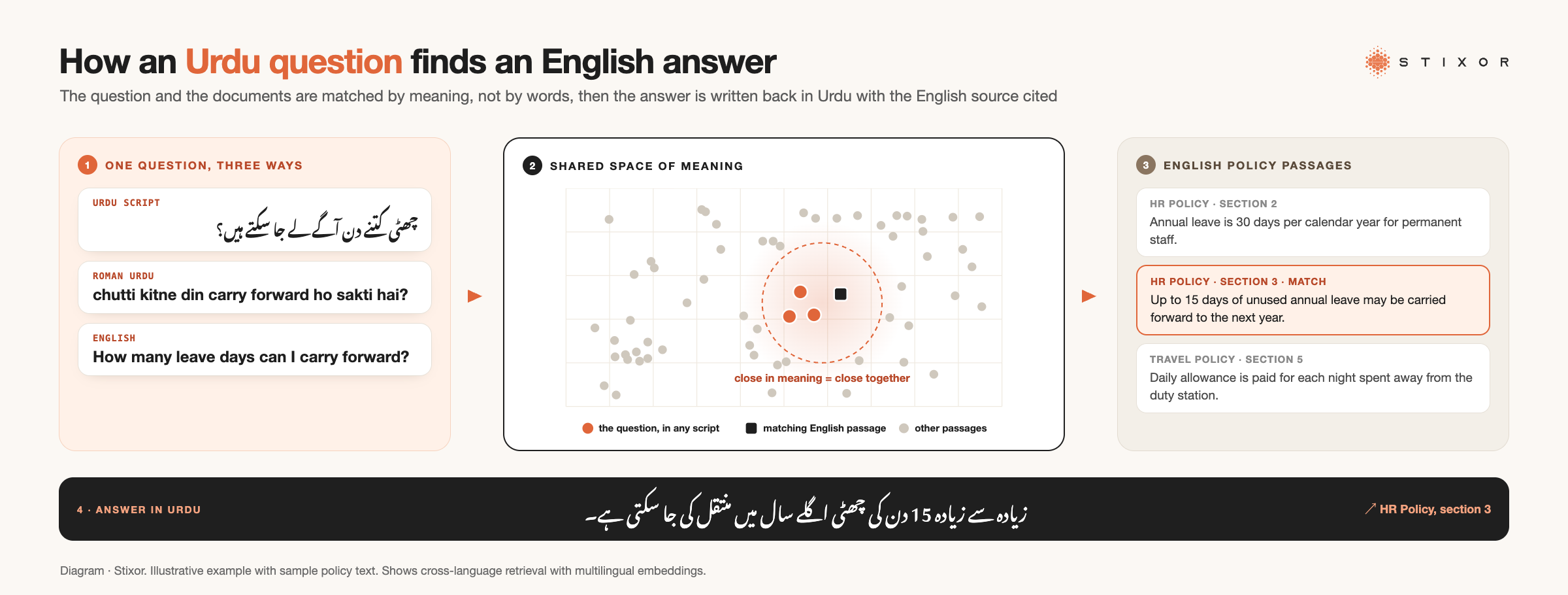
Figure: How an Urdu question finds an English answer. The question, written in Urdu script or Roman Urdu, and the English policy passages are mapped to the same space of meaning, matched, and the answer is written back in Urdu with the English source cited. Diagram · Stixor
Step by step
- The employee asks in their own words, for example "چھٹی کتنے دن آگے لے جا سکتے ہیں؟" or in Roman Urdu, "chutti kitne din carry forward ho sakti hai?"
- Permissions are checked first. Documents this person may not see are removed before anything else.
- Meaning, not words, is matched. Multilingual models turn the question and each passage into numbers that represent meaning (called embeddings). An Urdu question about "chutti" and an English passage about "annual leave" land close together, so the right passage is found.
- Keywords are matched too. Names, numbers and abbreviations such as TA/DA or GP Fund are matched exactly, which catches what meaning alone can miss.
- The model answers in the user's language using only the retrieved passages, and cites each one.
- The employee checks the source, which is usually the English original, in one click.
This approach is called retrieval-augmented generation (RAG), from a peer-reviewed NeurIPS paper. For an Urdu assistant, its main benefit is that the answer comes from your document, not from what a model happens to know about Pakistani rules.
Why Is Urdu Hard for AI?
Urdu is hard for AI because it has far less training data than English, it is written in two scripts, Roman Urdu has no standard spelling, and people mix Urdu and English in the same sentence.
Researchers describe Urdu as a low-resource language. A study from researchers at LUMS and EMBL-EBI notes that Urdu has 70 million native speakers yet remains underrepresented in natural language processing, and found that task-specific models outperformed general-purpose ones on Urdu tasks. In practice, five things trip assistants up:
| Challenge | What it looks like | What a good assistant does |
|---|---|---|
| Less training data | Answers in stiff or incorrect Urdu | Answers from your documents and keeps wording simple |
| Roman Urdu spelling | "nahi", "nahin", "nai" all mean the same | Matches by meaning, not exact spelling |
| Code-mixing | "Mera reimbursement claim kab tak process hoga?" | Understands mixed Urdu and English in one question |
| Script and direction | Nastaliq script, written right to left | Displays Urdu correctly and keeps English terms readable |
| Scanned documents | Old Urdu notifications stored as images | Needs the scans converted to searchable text first |
Roman Urdu deserves extra attention. A recent benchmark on Urdu idioms found that large language models were relatively stable on Urdu script, but that the lack of standard spelling in Romanized Urdu caused substantial consistency problems. Since much of Pakistan's workplace texting happens in Roman Urdu, test it as carefully as Urdu script.
What Should a Business Urdu AI Assistant Do?
A business Urdu AI assistant should understand Urdu script, Roman Urdu and English, answer from your own documents with citations, follow access rights, handle mixed-language questions, and run where your data rules allow.
- Three scripts, one answer. The same question in Urdu, Roman Urdu or English should return the same answer and the same source.
- Cross-language retrieval. Urdu questions must find English documents, and English questions must find Urdu ones.
- Answer in the user's language, while keeping official English terms where people expect them, such as "Grade 17" or "NOC".
- Citations to the exact passage, so the user can read the original wording.
- Permission-aware answers, so staff only get answers from files they can open.
- Where it runs. On-premise, air-gapped or hosted in Pakistan for sensitive data. For why that matters, see our enterprise AI knowledge assistant guide.
What Can Teams Do With an Urdu AI Assistant?
Teams use an Urdu AI assistant to answer policy questions, brief field staff, explain rules to customers and citizens, and onboard new employees in the language they are comfortable with.
Banks, telecoms and retail chains
Branch staff ask about product rules, account procedures or return policies in Roman Urdu and get the answer from the head-office manual, with the clause to show a customer.
Government departments
Officers and assistants check service rules, leave and pension procedures or procurement guidelines in Urdu, with the circular cited. Our guide to AI assistants for government departments covers the full requirement list.
Manufacturing, logistics and field operations
Supervisors on a site or in a warehouse ask for the current SOP in Urdu and get the steps from the English document, instead of calling the office.
HR and onboarding
New hires ask everyday questions, such as "probation kitne mahine ki hai?", and learn the organization's rules from its own documents.
How Do You Test an Urdu AI Assistant?
Test an Urdu AI assistant with a set of real questions written three ways, in Urdu script, Roman Urdu and English, then check that all three return the same correct answer with the same source.
- Collect 50 real questions from one team, the way they actually ask them, including spelling variations and mixed English.
- Write each question three ways: Urdu script, Roman Urdu and English.
- Record the correct answer and its source for each question.
- Run all 150 questions and check three things: is the answer correct, is the citation right, and is the Urdu natural and clear?
- Check consistency. If the English version is right but the Roman Urdu version is wrong, you have found a weakness before your users do.
- Test spelling variations of the same Roman Urdu question, such as "chutti", "chhutti" and "chuti".
- Test sensitive questions in Urdu and Roman Urdu too. Attempts to extract restricted information, which OWASP lists as prompt injection, are not limited to English.
Ask any vendor to run this test on your files, not on a demo set.
How Does Vizier AI Work as an Urdu AI Assistant?
Vizier AI is an enterprise AI knowledge assistant that answers in English, Urdu, Roman Urdu and Arabic from an organization's own documents and databases, cites the exact passage behind every answer, and shows each person only what they are allowed to see.
- Ask in Urdu. Staff can type in Urdu script, Roman Urdu or English, or use voice input, and an Urdu question can be matched to an English document.
- Check the source. Every answer shows numbered citations, and one click opens the exact passage in the original file.
- Your systems, your rules. Vizier AI reads from SharePoint, OneDrive, Google Drive, Outlook, Gmail and databases such as PostgreSQL, MySQL, SQL Server and MariaDB, and follows roles and departments set by administrators.
- Beyond answers. Deep Research across many documents, and skills that produce an executive brief, an SOP or an Excel tracker.
- Where it runs. On-premise, fully air-gapped with no internet connection, or as a cloud service hosted in Pakistan.
To prepare your documents for any of this, read how to build an AI knowledge base for employees.
The Bottom Line
The test for an Urdu AI assistant is simple: ask the same question in Urdu, in Roman Urdu and in English, and see whether you get the same correct answer from the same page of your own document. If it passes on your files, your staff will use it, because for the first time the policy speaks their language.

Ask Your Own Files in Urdu, Roman Urdu or English
Vizier AI answers in your staff's language from your company or department documents, cites the exact passage, and keeps data on your servers or in Pakistan.
Frequently Asked Questions
FAQs
Yes. Several AI tools understand Urdu, but most are consumer apps. For business and government use, look for an assistant like Vizier AI that answers from your own documents in Urdu, Roman Urdu and English and cites the source.
Yes, but quality varies. Roman Urdu has no standard spelling, so the same word can be written several ways. Test with your staff's real messages, including spelling variations, before you choose a product.
Yes, with an assistant that supports cross-language retrieval. It matches the meaning of an Urdu question to English passages and answers in Urdu, citing the English source so you can check the original wording.
Only after the scans are converted to searchable text. Urdu script is harder to convert accurately than English, so check the converted text before indexing important documents.
Public chatbots can write in Urdu, but they answer from general knowledge, not from your documents, and they process questions on servers outside Pakistan. For company or government work, use an assistant that answers from your files and runs where your data rules allow.
Some do. Vizier AI supports English, Urdu, Roman Urdu and Arabic, which suits organizations in the Gulf with Urdu-speaking and Arabic-speaking staff.
Accuracy depends on the model, the documents and the task. Research still treats Urdu as a low-resource language, so answering from retrieved documents with citations, and testing on your own questions, matters more in Urdu than in English.
Yes. Vizier AI can run on-premise or fully air-gapped, so documents, questions and answers never leave your building, or as a cloud service hosted in Pakistan.


Discuss Your Enterprise Use Case
From small to large scale enterprises, we deliver next-gen AI, data engineering, and actionable insights.


