
AI Development Cost in 2026: What Drives the Price, With Ranges by Project Type

Written by Muhammad Rizwan
October 31, 2026
9 min Read
AI development cost in 2026 runs from roughly $25,000 for an AI feature built on a model API to $400,000 for an AI agent that acts inside several business systems, and past $1 million for an enterprise platform. These are illustrative build ranges. Data work, integrations, model choice and monthly usage decide where your project lands.
Direct answer: AI development cost is the build cost (people, data preparation, integration, evaluation and security) plus the run cost (model usage, hosting, monitoring and retraining). People and data work drive the build bill; model usage drives the monthly bill. Budget both before approving either.
Key takeaways
- Price the project type, not "AI." A feature, a knowledge assistant, an agent and a custom model have very different scopes.
- Data preparation and integration often cost more than the model.
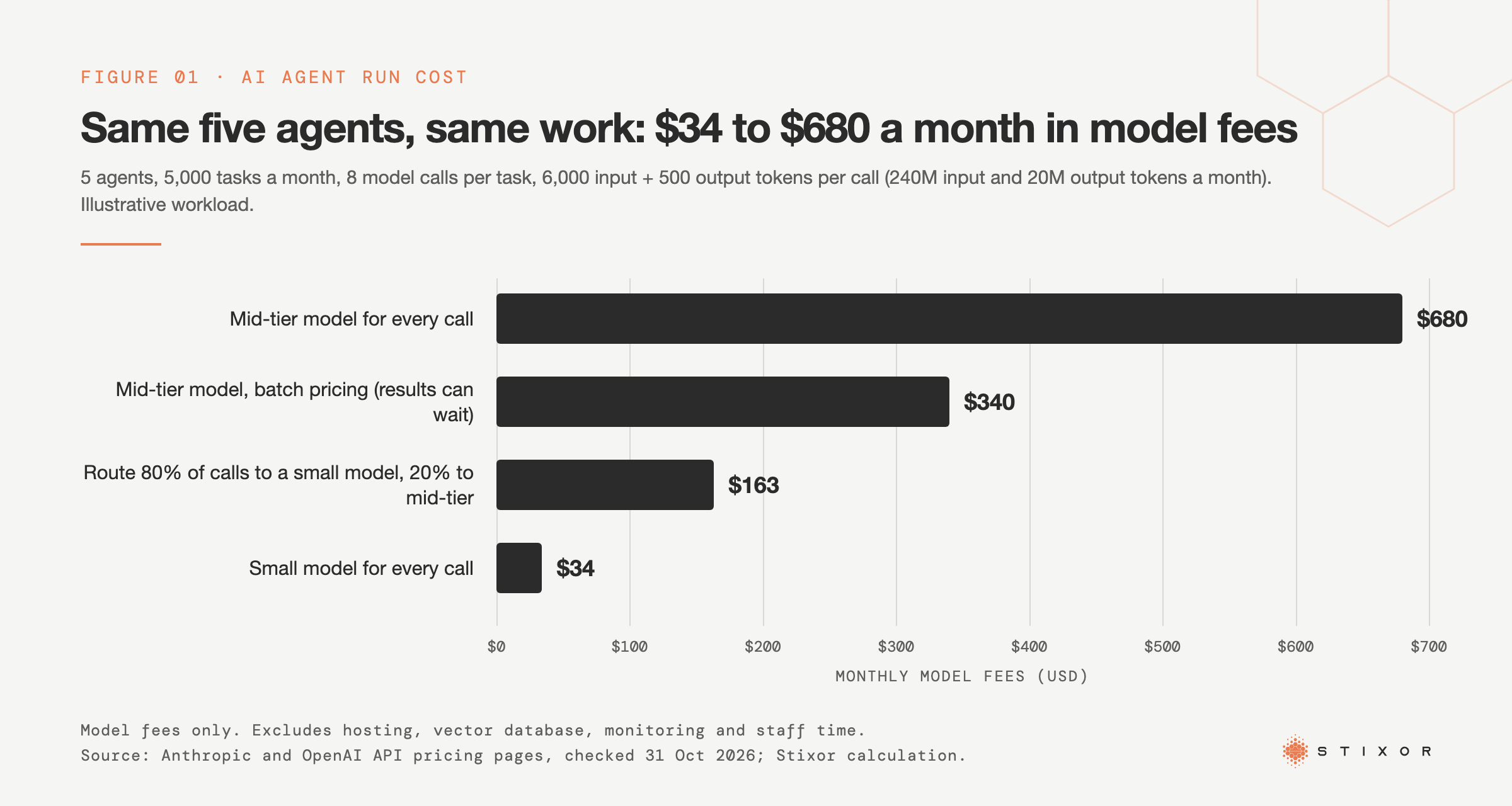
- The same five-agent workload costs about $34 or $680 a month in model fees, depending on model tier (October 2026 list prices).
- Agent projects carry the most budget risk: Gartner expects more than 40% of agentic AI projects to be scrapped by the end of 2027.
How Much Does AI Development Cost by Project Type?
Build costs range from about $25,000 for a single AI feature to more than $1 million for an enterprise platform, and the jumps between tiers come from integrations, data and risk controls.
The ranges below are illustrative estimates, not survey data. Most published AI cost figures come from agencies that define scope differently, so we show the math instead: team size times duration times a blended rate of $12,000 to $20,000 per person-month. That rate is our working assumption for a US or Western European delivery team. Change the rate and the ranges move with it.
1. AI feature on a model API ($25,000 to $80,000). Two people for one to two months. Think ticket summaries or invoice field extraction. You rent the model, so the work is prompts, testing and wiring the output into your product.
2. RAG knowledge assistant ($70,000 to $240,000). Three people for two to four months. RAG (retrieval-augmented generation) means the assistant looks up your documents before it answers. Cost rises with the number and mess of sources, and with per-user access rules.
3. AI agent with tool use ($100,000 to $400,000). Three to four people for three to five months. An agent plans steps and acts in other systems, such as updating a CRM record. Each connected system adds integration and failure testing, because a wrong action costs more than a wrong answer.
4. Custom machine learning model ($110,000 to $600,000). Three to five people for three to six months, for work like fraud scoring or demand forecasting on your own data. Cleaning data and validating results take most of the time.
5. Computer vision system ($150,000 to $800,000). Three to five people for four to eight months, plus image labeling and often cameras or edge hardware. Varied lighting, angles and defect types push cost up.
6. Enterprise AI platform ($430,000 to $2.4 million and up). Six to ten people for six to twelve months. This covers shared data pipelines, governance, access control and MLOps for several use cases at once.
Team location moves the blended rate more than any other input. Onshore teams cost the most and share your hours, nearshore teams sit a few time zones away at a lower rate, and offshore teams cost least per hour but need tighter specs. Many companies keep product ownership onshore and place engineering where skills and rates fit.
What Drives AI Development Cost?
Seven cost drivers decide most AI budgets, and the model itself is often the smallest of them.
Data preparation. Finding, cleaning, labeling and joining data is the slowest part of most projects. Data spread across five systems with no shared customer ID means weeks of work before any model sees it.
Integration. Connecting AI to your ERP, CRM, document stores and identity system takes time on both sides. Old systems without clean APIs add cost fast.
Model choice: API or open-weight. A hosted API bills per token and is cheapest to start. An open-weight model runs on your own infrastructure, avoids per-token fees and keeps data in your environment, but you pay for GPUs and the people who run them. Our guide to choosing the right open-source LLM covers the selection.
Inference. This is the cost of using a model after it is built. On an API you pay per million tokens (a token is roughly a short word or part of one). Self-hosted, you pay for GPU hours whether the GPUs are busy or idle.
Evaluation and guardrails. Test sets, scoring, human review of edge cases, and controls that block unsafe output. Agents need tests for every action they can take.
MLOps. Deployment pipelines, monitoring, version control for models and prompts, and retraining. Skipping it lowers the first invoice and raises every one after. See our MLOps services.
Security and compliance. Access control, audit logs, data residency, privacy reviews and, in the EU, AI Act duties for some use cases. Banking and healthcare spend more here.
Stixor's real-time fraud detection case study shows these drivers in production: scoring models, graph analytics and a rules engine trained on more than 24 months of data with 1,000+ real-time features, served through a real-time scoring API with automated retraining and monitoring. Each part is a budget line, and most keep costing money after launch.
What Does It Cost to Run AI Agents Every Month?
Five AI agents on a moderate workload cost roughly $34 to $680 a month in model fees, depending on model tier, and the people who monitor them often cost more than the tokens.
This worked example uses list prices checked on 31 October 2026. The workload is illustrative: 5 agents, each completing 1,000 tasks a month, with 8 model calls per task and 6,000 input plus 500 output tokens per call. That totals 240 million input tokens and 20 million output tokens a month.
Mid-tier models ($2 per million input tokens, $10 per million output). Anthropic's pricing page lists this rate for Claude Sonnet 5.5, and OpenAI's API pricing page lists it for gpt-6.1-sol. Cost: 240 x $2 + 20 x $10 = $680 a month.
Small models ($0.10 input, $0.50 output). Claude Haiku 5.5 (prompts up to 100,000 tokens) and gpt-6-luna list this rate. Cost: $34 a month.
Routing 80% of calls to the small model. Simple steps like classifying a request go small, hard reasoning goes to the mid-tier model. Cost: about $163 a month.
Batch pricing. Anthropic, OpenAI and Google list batch rates at half of standard. If the tasks can wait for results, the mid-tier bill drops to $340 a month.
Three cautions apply. Volume scales the bill directly: at 10,000 tasks per agent, the mid-tier cost becomes $6,800 a month. Token counts also differ by model. Anthropic notes that its newer tokenizer produces about 30% more tokens for the same text, so equal list prices do not mean equal bills. And prices change on a schedule. The Gemini API pricing page lists Gemini 3.8 Flash at $0.75 input and $3.75 output per million tokens through 31 December 2026, doubling from 1 January 2027.
Model fees are only part of the run cost. Add hosting, a vector database, monitoring tools and the engineer who reviews failed runs. One engineer-day a week costs more than $680 a month at almost any rate. Prompt caching also helps: both mid-tier models above bill cached input at $0.10 per million tokens instead of $2, which matters when every call repeats the same long instructions.
Is AI Getting Cheaper to Build and Run?
Running a model of fixed quality has become far cheaper, but total project budgets have not fallen at the same pace, because people, data and integration work did not get cheaper.
Stanford's 2025 AI Index reports that the inference cost for a system performing at the level of GPT-3.5 dropped over 280-fold between November 2022 and October 2024.
Build budgets have not followed. Models now take more steps and act in more systems, which adds tokens, tests and integration work. A Gartner analyst, quoted by Silicon.eu, said "many companies underestimate the true costs and complexity of deploying AI agents at scale." In June 2025 Gartner forecast that more than 40% of agentic AI projects will be scrapped by the end of 2027, citing cost, unclear value and weak risk controls, as reported by Mobile World Live.
Should You Build, Buy or Combine AI?
Buy when a tool already does the job, build when value depends on your own data or process, and combine the two in most other cases.
Buy. Low upfront cost and live in days, but fees grow with users and competitors get the same features.
Build. The highest upfront cost, but you own the logic, keep data in your environment and control cost per task. It pays off at high, steady usage or when the use case is core to how you compete.
Hybrid. Rent or host proven models and build only the retrieval, workflow and controls around them. Many custom AI projects take this route, and it sits in the middle of the ranges above.
Buying is often the safer first move. In MIT's 2025 study of enterprise generative AI, as covered by Fortune, buying from specialized vendors and building partnerships succeeded about 67% of the time, while internal builds succeeded only a third as often. Our guide to custom AI vs off-the-shelf AI walks through the decision.
How Can You Reduce AI Development Cost?
Cut scope before you cut rates: one narrow use case, the smallest model that passes your tests, and cost controls from day one.
- Start with one workflow and one metric. A proof of concept costs far less than a platform.
- Settle data access first. Agree on sources, owners and permissions before engineers start, so you do not pay them to wait.
- Route by difficulty. Small models for simple steps, larger ones for hard reasoning.
- Cache and batch. Reuse long system prompts and batch anything that can wait.
- Cap tokens per task. Limit agent steps and context length, and alert when a task goes over.
- Build evaluation early. A test set of real examples prevents costly rework after launch.
AI Budget Checklist
Answer these seven questions before you ask anyone for a quote.
1. Which single workflow changes, and how will you measure it?
2. Which project type is it: feature, assistant, agent, custom model, vision or platform?
3. Where does the data live, who owns it, and how clean is it?
4. Which systems must the AI read from or write to?
5. Must the data stay in your environment or a specific country?
6. How many tasks a month do you expect in year one, and can a small model handle most of them?
7. Who will monitor and improve the system, and what is the two-to-three-year cost, build plus run?
How Stixor Helps You Budget and Build AI
Stixor scopes each AI use case, estimates build and run cost together, and then builds and operates the system.
Stixor Technologies builds and runs production AI for large organizations, with offices in Dallas and Riyadh. We start with the workflow and data, recommend buy, build or hybrid per use case, size the model setup to your volume, then build and run it with MLOps from day one. See Enterprise AI & Machine Learning Solutions.
Who it suits: organizations with a defined use case and data they control. If a subscription tool already covers your need, buy it.
Related reading: Custom AI vs Off-the-Shelf AI, How to Choose the Right Open-Source LLM and MLOps Services.
The Bottom Line
Write down one workflow, its monthly task count, the systems involved and where the data must live, and any range above becomes a budget. To test it against a real scope, talk to our AI and ML team.

Get a Cost Estimate You Can Defend
Share your use case and we will map the build scope, monthly run cost and the cheapest model setup that still meets your quality bar.
Frequently Asked Questions
FAQs
An agent that takes actions in other business systems costs about $100,000 to $400,000 to build in our illustrative estimate, based on three to four people over three to five months. A narrow, read-only agent costs much less. Model fees come on top.
For 5,000 tasks a month at eight model calls each, model fees run about $34 on small models and $680 on mid-tier models, at list prices checked on 31 October 2026. Add hosting, monitoring and staff time.
Off-the-shelf tools cost a subscription or per-seat fee with little upfront. Custom AI costs tens to hundreds of thousands of dollars to build, but you control the data, logic and cost per task. Compare total cost over two to three years, run costs included.
Vendors scope different things: one quote includes data cleaning, integrations, evaluation and monitoring, another only a model and a demo. Ask each vendor for hours by cost driver and the expected monthly run cost.
At low or uneven volume, an API is usually cheaper because you pay only for tokens used. At high, steady volume, or when data must stay in your environment, hosting can cost less per task, but you pay for GPUs and staff even when idle.
Budget for model fees or GPU hosting, monitoring tools, retraining or prompt updates, and part of an engineer's time. Build the estimate from your expected monthly volume and how fast your data changes, not from a flat percentage of the build cost.


Discuss Your Enterprise Use Case
From small to large scale enterprises, we deliver next-gen AI, data engineering, and actionable insights.


