
Sovereign AI: why nations are building their own AI infrastructure and what it means for your enterprise

Written by Muhammad Rizwan
October 7, 2026
10 min
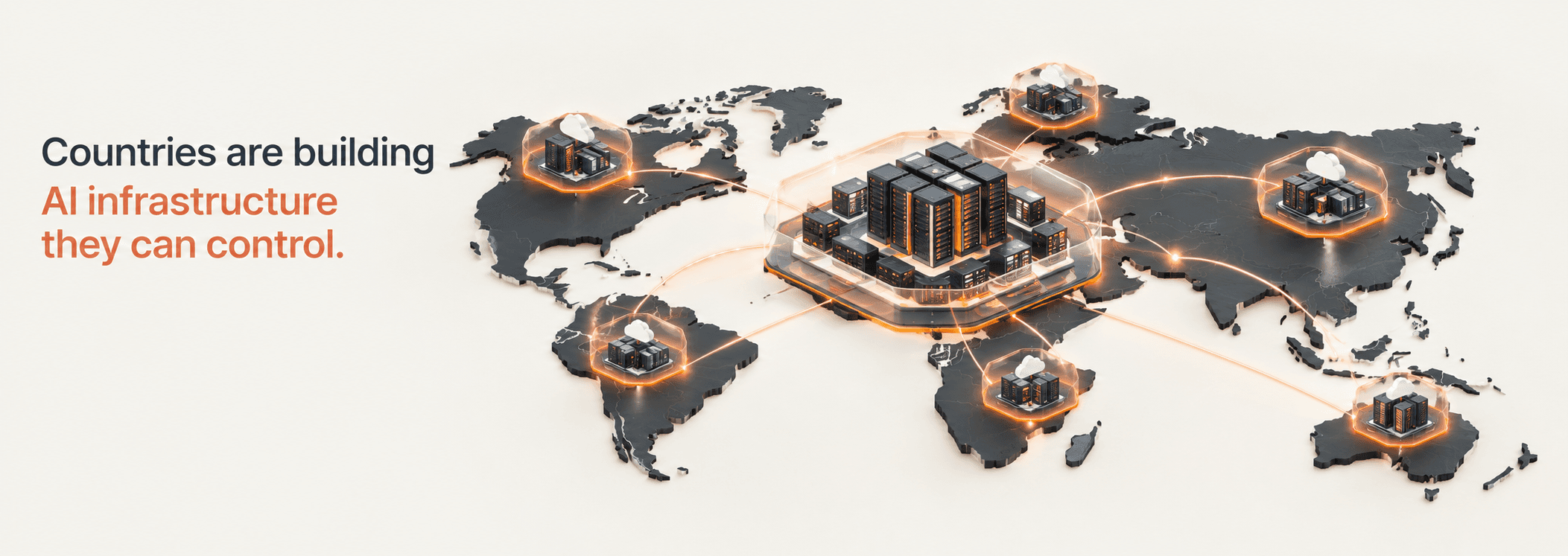
Sovereign AI is a nation's ability to develop, deploy, and govern artificial intelligence using its own compute, data, talent, and regulatory frameworks without critical dependence on foreign technology providers. It covers the full stack: domestic GPU clusters and data centers, data residency and privacy controls, foundation models trained on local languages and data, and governance through national AI strategy and regulation.
This is no longer a policy discussion. By early 2026, more than 60 nations have published formal AI strategies and domestic AI capability. Global spending on sovereign AI systems is projected to surpass $100 billion in 2026, with sovereign cloud infrastructure alone reaching $80 billion. The conversation has shifted from "what can AI do" to "who controls the engine."
At Stixor, we build AI infrastructure for organizations operating across sovereignty boundaries with offices in Islamabad, Riyadh, and Dallas, we help enterprises architect AI systems, GPU infrastructure, and data governance that satisfy the jurisdictions they operate in.
Three forces are driving sovereign AI investment simultaneously.
National security. AI systems increasingly control critical infrastructure, power grids, financial systems, defense, healthcare, public services. When those systems depend on compute and models hosted by foreign providers, a sanctions change, a pricing shift, or a policy decision in another country can disrupt your national capability. Governments have concluded that AI infrastructure is too strategically important to rent from someone else.
Economic competitiveness. Countries without domestic AI capability risk becoming permanent technology importers paying rent on foreign intelligence instead of building their own. The global AI spending forecast of $2.52 trillion in 2026 represents an economic shift that nations either participate in or watch from outside.
Data sovereignty without compute sovereignty doesn't work. A country can pass data residency laws, but if organizations train and run AI models on foreign cloud providers, the compute dependency creates the same vulnerability the data law was meant to prevent. This realization triggered the current wave of government investment: data sovereignty requires compute sovereignty, and compute sovereignty requires physical infrastructure within your borders.
The global sovereign AI race
Every country is running a variation of the same playbook. The differences are in scale, speed, and strategic emphasis.
Saudi Arabia
The Kingdom designated 2026 as the Year of Artificial Intelligence, backed by SDAIA's National Strategy for Data and AI. The PIF-backed HUMAIN is building 500 megawatts of sovereign compute with NVIDIA and AMD partnerships. The Allam project is developing sovereign Arabic-language foundation models for 420 million Arabic speakers. Saudi Arabia's PDPL (Personal Data Protection Law) adds regulatory enforcement to the infrastructure investment. As of Q1 2026, the Kingdom has approximately 420MW of data center capacity operational or under construction, a tenfold expansion from 45MW in 2020.
France
Projet Voltaire a national sovereign cloud facility powered by 50,000 NVIDIA H200 GPUs in partnership with OVHcloud is explicitly designed to train and run foundation models for public services insulated from foreign technology providers. France is making the European case that digital sovereignty requires control over hardware, not just regulation
European Union
The EU mobilized €20 billion for its AI Gigafactory program across member states. Germany hosts three semiconductor and AI facilities in Dresden, Munich, and Frankfurt. The EU AI Act’s high-risk obligations, originally due in August 2026, are being postponed to December 2027 for most systems under a provisional agreement reached in 2026. That creates the regulatory framework shaping how AI systems can be classified, documented, monitored, and deployed across European sovereign infrastructure. For any enterprise operating in Europe, the Act creates concrete obligations for high-risk AI systems.
Canada
Canada launched a $2 billion Sovereign AI Compute Strategy for nationally owned and operated supercomputing alongside a compute access fund for domestic researchers and enterprises. The $25 billion Canada Strong Fund targets critical infrastructure including AI and energy, positioning sovereign AI as industrial policy.
UAE and the Gulf
The UAE is deploying sovereign wealth fund capital across the AI value chain energy, real estate, chips, cloud at a pace that outstrips most national programs. Across the Gulf, the pattern repeats: resource wealth converting into AI infrastructure. The strategic risk is that capital alone doesn't build operational capability. The talent pipeline and institutional expertise to operate these facilities at scale is still developing.
Pakistan
Pakistan moved from moved from policy to operational sovereign AI infrastructure within about a year. The National AI Policy (July 2025) and Islamabad AI Declaration (February 2026) set the policy framework. Sky47 Karakoram-01 — an 8.5MW purpose-built AI data center launched in July 2026 alongside other providers building domestic AI compute. For the detailed analysis of Pakistan's infrastructure landscape and what it means for enterprises, see our deep dive on sovereign AI in Pakistan.
Japan, India, UK, Singapore
Japan committed to a national AI infrastructure initiative combining sovereign compute with domestic model development. India is building on its massive digital public infrastructure stack. The UK is pursuing specialization in AI safety and governance. Singapore is positioning as a regional AI hub through regulatory agility and talent attraction. Each follows the playbook adapted to national strengths.
What sovereign AI means for enterprises
This isn't just a government story. Sovereign AI creates practical requirements that affect infrastructure decisions, vendor selection, and system architecture for every enterprise operating across borders.
Data localization. Sovereign AI strategies increasingly mandate where AI models can train and where inference can run. If your organization operates in Saudi Arabia, the EU, Pakistan, or any jurisdiction with data residency requirements, your AI infrastructure must comply with where data physically lives and gets processed. This is driving demand for on-premise and in-country infrastructure over defaulting to US-based cloud regions.
Government procurement preferences. Countries with sovereign AI strategies increasingly favor domestic AI providers for government contracts. Organizations serving government clients in any sovereign-AI-active country need systems running on compliant domestic infrastructure.
Model sovereignty. An Arabic copilot for Saudi government services needs Arabic training data, local context, and compliant hosting. A French-language AI for public administration needs the same in French. A knowledge assistant for Pakistani banking needs to operate under SBP data rules on domestic infrastructure. English-first models on US cloud don't serve any of these adequately.
Regulatory patchwork. The EU AI Act, Saudi PDPL, Pakistan's pending PDPB, and emerging frameworks across Asia, Africa, and Latin America create a patchwork of AI governance requirements. Multi-country enterprises must navigate multiple, sometimes conflicting, sovereignty frameworks simultaneously. Data governance and compliance architecture is no longer optional infrastructure, it determines whether you can deploy at all.
Vendor lock-in risk grows. If your entire AI stack depends on one foreign provider, their models, their compute, their APIs ,you inherit their sovereignty exposure. An embargo, a sanctions change, or a policy shift by the provider's home government can disrupt your operations in a jurisdiction where you were compliant yesterday. Open-weight models (Llama, Mistral, DeepSeek) that run on domestic infrastructure reduce this risk.
How to architect for a sovereign AI world
Compute: choose where inference and training run per jurisdiction. Some workloads must stay domestic. Others can run on international cloud. Make that split explicit and document the rationale. GPU infrastructure decisions on-premise, sovereign cloud, or hyperscaler region should follow regulatory requirements and data sensitivity, not default to whatever's easiest.
Data: engineer residency into the architecture from day one. Data pipelines must be designed with sovereignty in mind, where data is stored, how it moves, who accesses it, and where it gets processed. Retrofitting data residency into a system designed without it is significantly more expensive than building it in. Every multi-jurisdiction enterprise that went through GDPR retrofit learned this lesson.
Operations: keep MLOps inside the boundary. Monitoring, retraining, drift detection, telemetry, and governance must run within the sovereign perimeter. Sending logs, model weights, or training data to a foreign provider for analysis defeats the sovereign architecture.
Compliance: map the patchwork before you build. Each jurisdiction adds requirements. Map which regulations apply to which data in which geography before committing to an architecture. A system designed for one jurisdiction's rules may violate another's. Governance and compliance architecture that accounts for multiple frameworks from the start prevents the expensive discovery that your production system can't deploy where you need it.
Why waiting costs more than building now
In an EDB survey of more than 2,000 executives in 13 countries, 95% said AI and data sovereignty will be mission critical within three years, and 30% had already made a strategic commitment. That gap between awareness and action is where risk accumulates.
Organizations that build sovereign AI capability now will have compliant infrastructure when regulations tighten, domestic compute capacity when demand exceeds supply, operational expertise when competitors are still learning, and government relationships when procurement mandates become standard.
Organizations that wait face the same retrofit that enterprises faced with GDPR — expensive, disruptive, and avoidable.

Build AI that stays within your borders.
Stixor designs GPU infrastructure, data governance, and on-premise AI for enterprises operating across sovereignty boundaries.
Frequently Asked Questions
FAQs
A country's ability to build, run, and govern AI using its own infrastructure, data, people, and rules, without depending on foreign providers for critical capabilities. It covers domestic compute, data sovereignty, domestic models, and national governance.
National security (critical AI shouldn't depend on foreign providers who can change terms), economic competitiveness (avoiding permanent technology import dependency), and the realization that data sovereignty requires compute sovereignty. Global sovereign AI spending is projected to exceed $100 billion in 2026.
No. It means compute and data processing happen within controlled, compliant boundaries. That can be on-premise GPU clusters, sovereign cloud providers operating within the country, or hyperscaler regions meeting local compliance requirements. The key is control over where data lives and how it's processed.
Over 60 nations have published formal AI strategies. The most active builders include Saudi Arabia, France, the EU, Canada, the UAE, Japan, Pakistan, India, the UK, Germany, and Singapore.
It creates concrete requirements: data localization (where models train and run), compliance (national AI governance frameworks), procurement preferences (government contracts requiring domestic AI), vendor risk (dependency on foreign providers), and architecture decisions (on-premise or sovereign cloud vs international cloud). Multi-country enterprises must satisfy multiple frameworks simultaneously.
Audit your AI data flows, where does data live, where does inference run, which models depend on foreign providers, and which workloads touch regulated data in sovereign jurisdictions. That audit is the foundation for every subsequent architecture decision.


Discuss Your Enterprise Use Case
From small to large scale enterprises, we deliver next-gen AI, data engineering, and actionable insights.


